
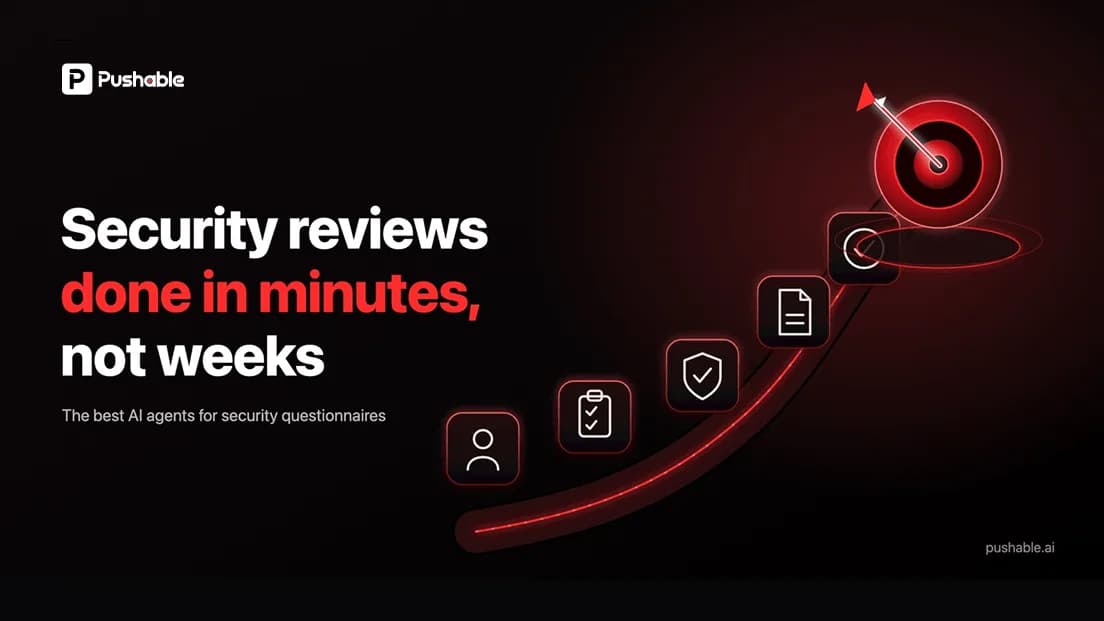
What's the Best AI Agent for Security Questionnaires in 2026?
Security questionnaires have quietly become one of the biggest taxes on B2B sales and GRC teams. So what's the best AI agent for security questionnaires in 2026? For most teams, it's Conveyor , especially for InfoSec-owned workflows. Skypher , SecurityPal , and Iris AI are close behind. Which one fits you best depends on your accuracy, speed, and budget needs. This guide compares eight tools so you can match one to your stack.
Key Takeaways
- The average company now manages 286 vendors, up from 237 in 2024 ( Whistic , 2025) - and each one can trigger a questionnaire.
- A single complex questionnaire eats 5–15 hours of expert time. Some take 30 business days ( SC Media , 2025).
- Top AI agents report 95–96% first-draft accuracy when grounded in your own documents ( Conveyor ; Skypher , 2025).
- The third-party risk management market hits ~$11.75B in 2026. It's growing at ~16% CAGR ( Fortune Business Insights , 2026).
Filling out a vendor security questionnaire used to mean a spreadsheet, a deadline, and a Slack thread begging three teams for answers. That model is breaking. Buyers send more questionnaires than ever. The people answering them are drowning. AI agents promise to read your evidence, draft answers, cite sources, and hand a human the edge cases. But which one actually delivers? Here's what you'll learn: why questionnaires became a bottleneck, what separates a real AI agent from autocomplete, and which eight tools belong on your shortlist.
Why Are Security Questionnaires Such a Bottleneck?
In 2026, the volume problem is structural. The average company now manages 286 vendors, up from 237 in 2024 ( Whistic , 2025). And 98% of organizations have a relationship with a third party that has been breached ( SecurityScorecard ). More vendors plus more breaches means more scrutiny. That means more questionnaires landing in your queue.
The time cost is brutal. A typical questionnaire takes 2–4 hours. Complex assessments stretch to 5–15 hours of expert time. Some organizations report spending up to 30 business days on a single review when multiple departments weigh in ( SC Media , 2025).
According to EY data, 52% of companies say it takes 31–60 days to perform control assessments of third parties. Another 38% need 61–90 days. Just 8% finish within 7–30 days ( EY , 2023). That lag stalls deals. The questionnaire sits between your buyer's interest and their signature.
Most third-party assessments take one to three months. Source: EY, 2023.
It gets worse on the response side. Up to 75% of vendors either skip security questionnaires entirely or answer them late ( Viso Trust ). When the people answering are this overloaded, automation stops being a nice-to-have.
See how leading teams hand repetitive work to AI agents instead of grinding through every request by hand.
What Makes an AI Agent Good at Security Questionnaires?
A real AI agent for security questionnaires does three things autocomplete cannot. It grounds answers in your actual evidence. It scores its own confidence. And it routes the uncertain cases to a human. The gap between a 95% useful tool and a 50% one comes down to one thing: where it gets its answers.
The strongest platforms ground their answers in your internal content - past responses, policies, SOC 2 reports - instead of letting a generic model guess. They offer confidence scoring per answer. They support multi-format ingestion (Excel, Word, PDF, Google Sheets, and web portals). And they include audit trails that trace every answer back to a source document.
Our take: The "AI agent" label gets stretched. A true agent reads the questionnaire, retrieves evidence, drafts a sourced answer, flags low-confidence items, and learns from your edits. A glorified search-and-suggest tool just matches questions to a library you built by hand. Ask vendors which one they actually are.
Watch for the grounding gap. Vanta's AI auto-generates answers, but only for Excel files under 2MB, and only without dropdowns. It also relies on a question-and-answer bank rather than reading your documents, past answers, or outside sources ( Vanta , 2026). That's fine for light use. It's not the same as an agent that ingests your full evidence library.
According to 2025 vendor reporting, the accuracy ceiling now sits near 95–96% for first-draft answers when the AI is grounded in your own content ( Conveyor ; Skypher , 2025). Treat any number above that with healthy skepticism. Always verify against your own questionnaires during a trial.
For broader context, see how AI assistants help SaaS teams scale operations without adding headcount.
The 8 Best AI Agents for Security Questionnaires in 2026
The best AI agent for security questionnaires depends on who owns the workflow - InfoSec, sales engineering, or a dedicated GRC team. Below are eight tools that consistently surface in 2026 buyer comparisons, each with a standout strength. Accuracy figures are vendor-reported, so verify them in a trial against your own data.
1. Conveyor - Best for InfoSec-owned workflows
Conveyor claims over 95% first-pass answer accuracy. Its AI trains on your prior responses and uploaded documentation, even without a pre-built answer library ( Conveyor , 2025). It pairs questionnaire automation with a public Trust Center, so many reviews get deflected before they reach a human. It's strongest where security owns the questionnaire workflow end to end.
2. Skypher - Best for speed at enterprise scale
Skypher is an agentic AI platform. It helps organizations respond ten times faster while maintaining 96% accuracy, and it's SOC 2 Type II compliant ( Skypher , 2025). Fortune 500 names like Adobe trust it, along with technology leaders such as Swile and Retool. That track record makes it a safe pick for larger, security-conscious buyers.
3. SecurityPal - Best for human-verified, defensible answers
SecurityPal combines AI Concierge Agents with certified security experts through its Hyper-Supervised Assurance Intelligence (H-SAI) approach ( SecurityPal , 2025). The result: fast, accurate, and defensible reviews at scale. It's ideal when you need a human signature behind every answer, not just AI confidence.
4. Iris AI - Best reviewer experience
Iris is rated 4.9/5 on G2 across 66+ reviews, and reviewers consistently cite its accuracy, speed, and ease of use ( Iris AI , 2025). It auto-fills 70–90% of questions from your verified knowledge base, with confidence scoring so reviewers focus only on edge cases. It's a strong choice if adoption and UX matter most to your team.
5. Arphie - Best for fast setup and source citations
Arphie reports an 84% acceptance rate, with source citations and confidence levels so teams can trust and verify AI responses quickly ( Arphie , 2026). Direct integration with Google Drive, SharePoint, and Confluence skips the weeks of setup that traditional platforms require. That's a real advantage for teams that don't want a long onboarding.
6. SafeBase (by Drata) - Best for deflecting questionnaires entirely
SafeBase takes a Trust Center–first approach. It says this reduces inbound questionnaires by 74% or more, with AI Questionnaire Assistance handling the ones that still come through ( SafeBase , 2025). The philosophy: the fastest questionnaire is the one you never have to answer. It's best for teams optimizing the top of the funnel.
7. Loopio - Best for teams with a mature answer library
Loopio is built around its Magic Answer engine, which matches incoming questions against your curated library and suggests the best response ( Loopio ). It shines when your team has already invested in a robust set of pre-approved answers. That makes it a strong fit for organizations with established RFP and questionnaire content.
8. Responsive - Best enterprise RFP-and-questionnaire platform
Responsive, which rebranded from RFPIO, is an enterprise-grade platform built on a massive content library. It has managed RFP and questionnaire responses for years ( Responsive ). If questionnaires are just one slice of a broader RFP operation, its breadth is hard to match.
The chart below compares vendor-reported accuracy claims. Treat these as a starting point for trials, not an apples-to-apples benchmark - they're marketing figures, and each company measures them differently. Conveyor and Skypher cite first-pass accuracy, while Arphie cites an acceptance rate.
Self-reported accuracy claims. Always validate against your own questionnaires.
Slow security reviews don't just frustrate GRC teams. They stall revenue, which is why many teams now automate the sales pipeline with AI agents .
How Do You Choose the Right AI Agent for Your Team ?
Match the tool to who owns the work, not to the highest accuracy number. A 96% claim means little if the platform doesn't fit your workflow or read your evidence. As of 2026, the third-party risk management market is projected to grow from ~$11.75 billion to ~$38.39 billion by 2034, at a ~15.95% CAGR ( Fortune Business Insights , 2026). Expect rapid feature change, and avoid long lock-in.
Use this quick decision guide:
- Security/InfoSec owns it → Conveyor or SecurityPal for grounded, defensible answers.
- You need raw speed at scale → Skypher, especially for enterprise buyers.
- Reviewer adoption is the risk → Iris AI for its ease of use.
- You want fast setup, no long onboarding → Arphie's drive integrations.
- You'd rather deflect questionnaires → SafeBase's Trust Center model.
- You already have a big answer library → Loopio or Responsive.
From the trenches: The teams that win the trial don't pick on a demo. They feed the AI a real, painful questionnaire they've already answered, then compare the draft line by line. The grounding quality - does it cite your SOC 2, not a hallucinated control - separates the contenders fast.
Whatever you choose, insist on a trial with your own questionnaires. Vendor accuracy claims are measured on their data, not yours.
Ready to cut your questionnaire turnaround? Shortlist two or three tools above. Run each against the same real questionnaire, and score the drafts on grounding, citations, and confidence. The right AI agent should hand your reviewer a near-final answer, not a starting point.
Conclusion
The best AI agent for security questionnaires in 2026 isn't a single winner. It's the one that fits who owns the work and grounds answers in your evidence.
- Conveyor and SecurityPal lead for InfoSec-owned, defensible reviews.
- Skypher wins on speed at enterprise scale; Iris AI on reviewer experience.
- SafeBase changes the game by deflecting questionnaires before they arrive.
The average company now manages 286 vendors ( Whistic , 2025), and questionnaire volume keeps climbing. Doing this by hand no longer scales. Shortlist two or three tools, trial them against your own painful questionnaire, and score the drafts on grounding and citations, not the demo.
Explore more AI agent guides and use cases on the Pushable blog .
Sources
- Whistic, State of Vendor Security 2025 (286 vendors, up from 237), retrieved 2026-06-26, https://www.whistic.com
- SecurityScorecard (98% have a breached third-party relationship), retrieved 2026-06-26, https://securityscorecard.com
- EY (control assessment timelines), 2023, retrieved 2026-06-26, https://www.ey.com
- SC Media, Time to streamline security questionnaires (5–15 hours; 30 business days), 2025, retrieved 2026-06-26, https://www.scworld.com/perspective/time-to-streamline-security-questionnaires
- Viso Trust (75% of vendors don't respond timely), retrieved 2026-06-26, https://visotrust.com
- Conveyor (95%+ first-pass accuracy), 2025, retrieved 2026-06-26, https://www.conveyor.com
- Skypher (96% accuracy, 10x faster, SOC 2 Type II), 2025, retrieved 2026-06-26, https://www.skypher.co
- SecurityPal (H-SAI, AI + certified experts), 2025, retrieved 2026-06-26, https://www.securitypalhq.com
- Iris AI (4.9/5 on G2, 70–90% auto-fill), 2025, retrieved 2026-06-26, https://heyiris.ai/blog/best-ai-for-security-questionnaires
- Arphie (84% acceptance rate with citations), 2026, retrieved 2026-06-26, https://www.arphie.ai/blog/best-ai-tools-security-questionnaire-automation
- SafeBase (74%+ questionnaire reduction), 2025, retrieved 2026-06-26, https://safebase.io
- Vanta (Q&A bank limits), 2026, retrieved 2026-06-26, https://www.vanta.com/resources/best-security-questionnaire-automation-software
- Fortune Business Insights (TPRM market size and CAGR), 2026, retrieved 2026-06-26, https://www.fortunebusinessinsights.com/third-party-risk-management-market-117395