
AI Software Development in 2026: From Faster Code to Governed, Agentic Delivery
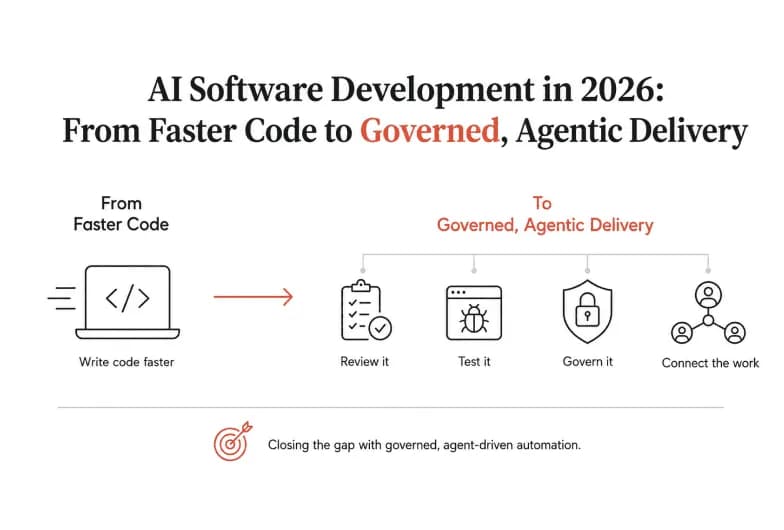
AI software development has crossed the line from experiment to default. In under three years, writing code with an AI assistant went from a novelty to the baseline expectation on most engineering teams. But the interesting story in 2026 isn't that AI helps you type faster - it's that the bottleneck has moved. The hard part of AI software development is no longer generating code; it's reviewing it, testing it, governing it, and connecting all the work that surrounds shipping software. This guide covers where AI genuinely helps across the software development lifecycle, where it quietly creates new risk, and how teams are closing the gap with governed, agent-driven automation.
What "AI software development" actually means now
AI software development is the practice of using artificial intelligence - large language models, code assistants, and autonomous agents - to plan, write, review, test, deploy, and maintain software. It spans three layers that are worth separating clearly:
- AI-assisted coding: in-editor tools that autocomplete, refactor, and explain code (the GitHub Copilot / ChatGPT / Claude layer).
- AI in the SDLC: applying AI to requirements, design, testing, code review, documentation, and incident response.
- Agentic development and operations: autonomous or semi-autonomous agents that execute multi-step workflows - triaging issues, running checks, syncing tools, and handling the operational work around engineering - with a human approving the consequential steps.
Most teams have thoroughly adopted the first layer. The competitive advantage in 2026 is being built in the second and third.
The state of AI software development in 2026
Adoption is effectively universal, but trust has not kept pace. The most-cited industry surveys converge on a clear picture:
Metric | Figure | Source |
|---|---|---|
Developers using or planning to use AI tools | ~84% (up from 76% in 2024) | Stack Overflow Developer Survey 2025 |
Professional developers regularly using AI tools | ~85% | JetBrains State of Developer Ecosystem 2025 |
Professional developers using AI tools daily | ~51% | Industry surveys, 2026 |
Organizations using or evaluating AI in development | ~97% | Industry reporting, 2026 |
Projected productivity gain across the dev process | 30–35% | Deloitte 2026 Software Industry Outlook |
Developers who distrust AI output | ~46% | Industry reporting, 2026 |
The headline is adoption; the subtext is caution. Reporting compiled from the 2025 developer surveys notes that fewer than a third of developers fully trust what AI produces - a figure that actually fell year over year even as usage climbed to record highs. The most common complaint is memorable: AI solutions that are "almost right, but not quite," cited by roughly two-thirds of developers. That gap between "looks correct" and "is correct" is the entire game.
Where AI genuinely accelerates the SDLC
AI is not uniformly useful across the lifecycle. It shines where the task is scoped, patterned, and quickly verifiable - and struggles where the task requires deep context and judgment.
Strong fit today:
- Boilerplate and scaffolding. Generating routine code, config, and glue is where measured gains are largest. A widely cited controlled GitHub study found developers completed a scoped JavaScript task roughly 56% faster with an AI pair programmer, and GitHub's research reported that the large majority of developers finished tasks faster overall.
- Refactoring and translation. Moving between languages, modernizing legacy patterns, and mechanical refactors.
- Documentation and tests. Drafting docstrings, README content, and first-pass unit tests.
- Explaining unfamiliar code. Onboarding into a new codebase far faster than reading cold.
Weak fit - still needs humans:
- Complex business logic. Anything requiring contextual understanding of why the system exists.
- Architecture and design trade-offs. High-stakes decisions where being "almost right" is expensive.
- Maintenance in messy, real-world codebases. Where AI confidently produces plausible-but-wrong changes.
The pattern is consistent across the research: AI is excellent at task-level speed and unreliable at system-level correctness. Treat it like an extremely fast junior developer - helpful, tireless, and in constant need of review.
The new bottleneck: the "last mile" problem
Here is the trap most teams walk into. AI makes it dramatically easier to produce code, so more code gets produced. But software delivery isn't constrained by typing speed - it's constrained by review, testing, security, and integration. When you speed up only the generation step, you don't speed up delivery; you flood the downstream steps.
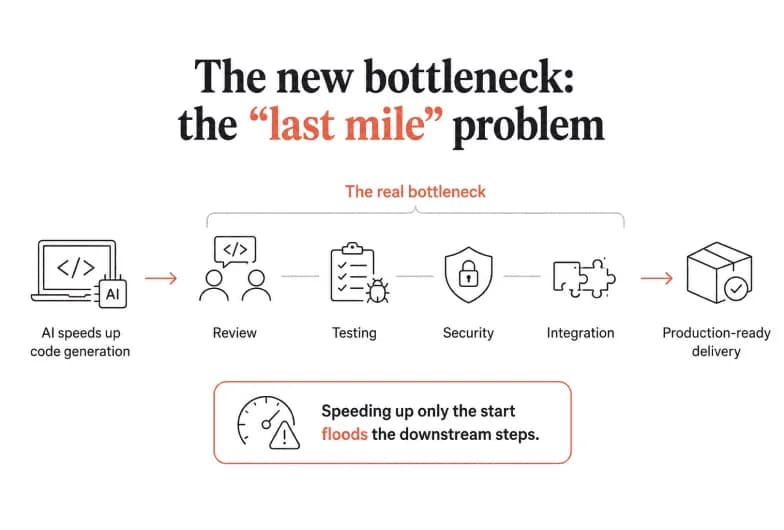
The data on this is striking. Analysis from Faros AI found that on high-adoption teams, code review time rose by around 91% - because more pull requests means more to review, not less. Separate research from Harness reported that roughly 70% of developers spend extra time debugging AI-generated code, and about 45% say debugging AI output takes longer than writing it themselves. And a Tricentis quality report found that a majority of enterprises admit to shipping code that wasn't fully tested as AI accelerated their output.
In other words: AI can make you faster at shipping problems. The productivity win is real, but it only converts into business value when the speed reaches the end of the pipeline - reviewed, tested, governed, production-ready software - not just the start.
This is why the most important question for engineering leaders in 2026 is no longer "should we adopt AI?" It's "how do we govern it so speed becomes throughput instead of risk?"
The shift: from writing code to orchestrating agents
The abstraction level of software development keeps rising. Assembly gave way to high-level languages; procedural code gave way to object-oriented; monoliths gave way to microservices. Each shift let developers think at a higher level and let machines handle more of the mechanics.
AI is the next step in that progression. Increasingly, the highest-leverage work isn't writing every line - it's specifying intent clearly and directing agents that execute multi-step work, then reviewing the results. The developer's role moves toward orchestration: defining what needs to happen, wiring agents to the right tools and data, setting the guardrails, and approving the moments that matter.
That's a profound change, and it extends well beyond the IDE. A huge share of an engineering organization's time isn't spent writing product code at all - it's spent on the connective work around the code: triaging incoming bugs, keeping issue trackers in sync, chasing status updates, generating reports, routing incidents, updating documentation, onboarding, and reconciling data across a dozen tools. This is exactly the operational surface where agentic automation delivers compounding returns - and exactly where governance matters most.
What "good" looks like: governed, agentic automation
If the risk of AI software development is unmanaged speed, the antidote is a system with four properties:
- Shared context. Agents grounded in the team's real knowledge base, files, and data - not a blank chat window with no memory of how your business actually works.
- Human-in-the-loop control. Consequential actions pause for a human decision. Approval gates turn "autonomous and scary" into "autonomous and safe."
- Real tool access. Agents that can actually read and write to the systems your team uses - issue trackers, inboxes, spreadsheets, CRMs, databases - instead of producing text you have to copy-paste.
- Always-on execution with an audit trail. Work that runs continuously on schedules and triggers, with clear ownership and a record of what happened.
Notice that none of these are about the model being smarter. They're about the system around the model being accountable. That's the difference between an AI demo and AI you can put in front of real business operations.
How Pushable fits: the shared AI workspace for agentic work
This is where Pushable comes in. Most AI tools are built for one person typing into a chat box. Pushable is built as a shared AI workspace - an execution layer for the whole team, designed around exactly the four properties above.
Here's what that looks like in practice for teams building and running software:
- Deploy agents that run workflows around the clock. Pushable's agents are cloud-native and always on. They run on schedules and event triggers even when no one has the app open - so recurring engineering-adjacent work (nightly reports, monitoring, ticket triage, data syncs) just happens.
- Human-in-the-loop by default. Every consequential action can pause for approval. Pushable's approval gates and Telegram-based notify-and-approve flows let a human sign off from a laptop or phone before an agent acts. That's the governance layer the trust data says teams are missing.
- Grounded in your real context. Knowledge base, database, files, and memory live in one shared workspace tenant, so every agent acts on your actual business context instead of starting cold.
- Connected to the tools you already use. With 100+ native integrations plus custom MCP connectors - including Slack, Gmail, Jira, Linear, HubSpot, Notion, Airtable, Supabase, Google Sheets and more - agents can read and write to the systems your team lives in.
- No-code and low-code agent builder. Teams build and deploy agents in minutes with role-based access from day one - no separate AI setup for every user, and no dedicated IT project to stand it up.
- You pay for results, not seats. Pushable's credit model charges when an agent actually completes a task - a message sent, a report filed, a workflow triggered - rather than a flat per-seat fee whether it's used or not.
Concretely, an engineering or product team might use Pushable to auto-triage inbound bug reports and route them to the right owner in Jira or Linear, compile a daily standup or weekly progress report from activity across tools, watch for incidents and notify the on-call human for approval before escalating, keep documentation and knowledge bases in sync, and handle the recurring finance/ops/support workflows that otherwise steal focus from shipping. The agents do the connective work; the humans approve the decisions that matter.
The point isn't that Pushable writes your production code for you - your IDE copilots are great at the last 200 lines. The point is that Pushable governs and automates the workflow around software delivery, which is precisely where the 2026 bottleneck actually lives.
Try it: Pushable offers a free tier to start (200 monthly credits, no commitment), with Starter and Pro plans as you scale and Enterprise options for security, SSO, and SLAs. You can spin up a workspace and deploy your first agent at www.pushable.ai.
A practical rollout checklist for AI software development
If you're formalizing AI adoption this year, these steps consistently separate teams that get throughput from teams that just get more pull requests:
- Instrument before you accelerate. Only about a fifth of teams track the real impact of AI coding tools with engineering metrics. Decide your delivery metrics (cycle time, review time, change-failure rate, escaped defects) first.
- Scale review, not just generation. Add review capacity, automated checks, and security scanning proportional to your new output. If review can't keep up, delivery won't either.
- Put a human on the consequential actions. Use approval gates for anything that touches production, customers, money, or data.
- Ground agents in real context. Connect your actual tools and knowledge base so agents act on reality, not guesses.
- Start with the boring, high-frequency workflows. Triage, reporting, syncing, routing - the repetitive glue work - is where automation pays back fastest and safest.
- Keep an audit trail. Know what every agent did, when, and on whose approval.
The honest bottom line
AI software development in 2026 is real, widespread, and genuinely valuable - but the value is not automatic. Adoption is near-universal; trust is not. Speed at the keyboard is easy; throughput to production is hard. The teams winning right now aren't the ones with the most AI-generated code - they're the ones who've built a system where AI's speed is matched by human governance and connected execution.
That's the shift worth internalizing: from writing more code faster to orchestrating governed agents that get real work done. The first is a productivity tweak. The second is a new operating model - and it's the one that turns AI from a risky accelerant into a durable advantage.
The statistics cited here are drawn from third-party industry research (Stack Overflow, JetBrains, Deloitte, GitHub, Faros AI, Harness, Tricentis and related 2025–2026 reporting) and reflect widely reported figures rather than internal Google or vendor-verified rankings. Treat them as directional benchmarks and validate against your own delivery metrics.