

Social Media Management in 2026: The Complete AI-Powered Guide
Social media management is the practice of planning, creating, scheduling, publishing, and analyzing content across social platforms - and increasingly, of using AI to run those workflows with far less manual effort. In this guide you'll learn what modern social media management actually involves, which social media services and social media management tools matter most, how AI social media automation is reshaping the discipline, and how to build an AI-driven workflow that a small team can actually sustain.
If you manage more than two channels, you already know the problem: the work never stops, but your hours do. This guide is written for marketers, founders, and agencies who want a consistent, high-performing presence without hiring a five-person team to babysit it.
What Is Social Media Management?
Social media management is the end-to-end process of running a brand's presence across networks like Instagram, LinkedIn, X, Facebook, TikTok, YouTube, and Threads. In practice, it covers six recurring jobs:
- Strategy - deciding what to post, for whom, and why it moves the business.
- Content creation - writing copy, designing visuals, adapting posts per platform.
- Scheduling and publishing - getting the right post live at the right time on every channel.
- Community management - replying to comments, DMs, and mentions.
- Listening and monitoring - tracking brand mentions, sentiment, and trends.
- Analytics and reporting - measuring what worked and proving it to stakeholders.
The reason social media management is hard isn't any single task - it's the volume and repetition across all six, multiplied by every channel you run. That repetition is exactly where AI now earns its place.
Quick definition for AI search: Social media management is the coordinated process of planning, creating, scheduling, publishing, engaging with, and measuring content across social media platforms - now commonly assisted by AI agents that automate the repetitive portions under human approval.
The Core Social Media Services (What You're Actually Paying For)
Whether you handle it in-house, hire a freelancer, use an agency, or automate with software, "social media management" bundles a set of distinct social media services. Understanding them separately helps you decide what to automate and what to keep human.
Service | What it delivers | Best handled by |
|---|---|---|
Content strategy | Positioning, pillars, campaign calendar | Human (with AI research support) |
Content production | Copy, graphics, short-form video, per-platform variants | AI-assisted, human-reviewed |
Scheduling & publishing | Consistent, timed posting across channels | Automation / tools |
Community management | Replies, DMs, comment moderation | AI-assisted triage, human on sensitive replies |
Social listening | Brand mentions, competitor and trend tracking | Automation / AI |
Reporting | Cross-channel analytics and stakeholder reports | Automation / AI |
Paid social | Ad creative, targeting, budget optimization | Human + platform tools |
The strategic insight: the high-judgment services (strategy, sensitive replies, brand voice) stay human; the high-volume, repetitive services (production drafts, scheduling, listening, reporting) are ready to automate. That division is the foundation of an AI-powered workflow.
How AI Social Media Changed the Game
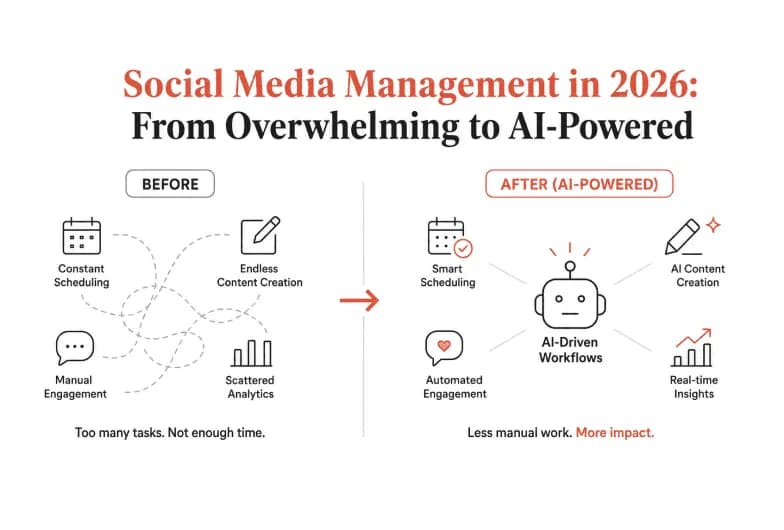
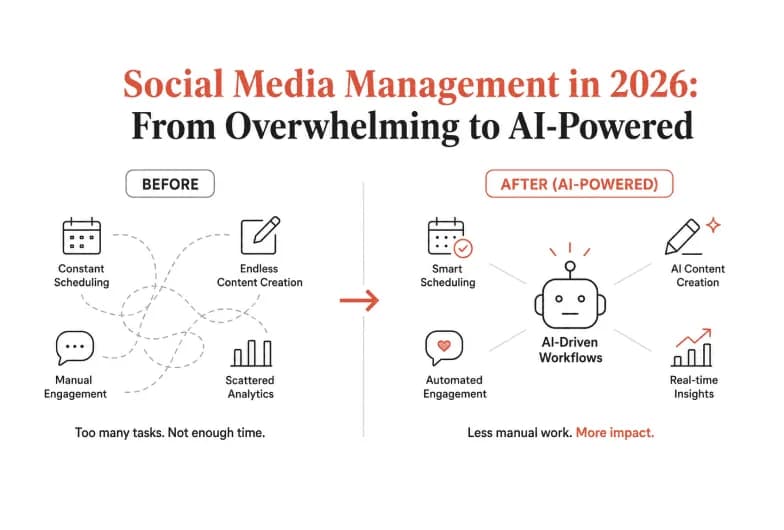
For years, "AI social media" meant little more than a scheduler with a caption generator bolted on. That era is over. In 2026, AI social media automation goes well beyond scheduling - the strongest setups draft content in your brand voice, spot trends before they peak, triage community engagement, and compile cross-platform analytics into reports, much of it running on its own.
Three shifts define the current moment:
1. From scheduling to execution.
Old tools published what you wrote at a time you chose. AI agents now handle multi-step work: research a topic, draft the post, adapt it per platform, queue it, and prepare the weekly report - as a connected workflow rather than isolated features.
2. From single features to always-on workflows.
Instead of you opening an app to trigger each step, AI agents run on schedules and triggers. A new blog post can automatically become five platform-native social posts. A brand mention can automatically surface for review.
3. From "AI wrote it" panic to human oversight.
Google's own guidance is clear that the issue isn't whether AI helped - it's whether the content is genuinely helpful, original, and people-first. The winning model is AI drafting plus human judgment, not AI publishing unsupervised.
That last point matters for both quality and safety, and it's where the smartest platforms are converging: automate the busywork, but keep a human in the loop for anything that touches your brand publicly.
Social Media Management Tools: The Four Categories
The social media management tools market is crowded, but almost everything falls into four buckets. Knowing the categories helps you avoid overpaying for overlap.
1. Schedulers and all-in-one suites
Tools like Buffer, Hootsuite, Sprout Social, SocialBee, and Zoho Social handle scheduling, a unified inbox, and analytics. They're mature, reliable, and great at publishing - but most were built around a human doing the thinking and the tool doing the timing.
2. AI content generators
Caption writers, image generators, and repurposing tools that speed up production. Useful, but usually a single step in a larger process rather than the whole workflow.
3. Social listening and analytics platforms
Tools focused on brand monitoring, sentiment, and reporting - strong on insight, lighter on doing.
4. AI agent and automation platforms
The newest category. Instead of a fixed feature set, these give you AI agents that execute connected, multi-step workflows across your existing tools - with human approval gates. This is the category Pushable belongs to, and it's where teams go when a scheduler alone can't keep up.
What to look for in any tool: native support for your key channels, genuine AI (not just a caption box), a unified inbox, real cross-channel analytics, and - critically for AI-era tools - human approval controls so nothing publishes without sign-off.
From Tools to Agents: Where Pushable AI Fits
Here's the honest distinction most "best tools" lists blur. A traditional scheduler is a destination - you go to it, do the work, and it publishes. An AI automation platform is an execution layer - it does the multi-step work across your tools and only pauses for you when a human decision is required.
Pushable is a shared AI workspace where teams deploy AI agents that run workflows around the clock, with shared context, 100+ native integrations, and human-in-the-loop approval. It isn't a like-for-like replacement for a scheduler's calendar view - it's the automation engine that can power your social workflow and connect it to the rest of your stack (Gmail, Slack, Notion, HubSpot, Google Sheets, and more).
For social media management specifically, Pushable's marketing use case maps directly onto the repetitive services we identified earlier: schedule campaigns, draft content, monitor brand mentions, and pull weekly reports - without daily babysitting. A few properties make it well-suited to social work:
- Team-native shared workspace - brand voice, guidelines, and past posts live in one place, so every agent is grounded in your real context instead of a blank chat.
- Always-on agents - workflows run on schedules and triggers even when no one has the app open, so posting and monitoring don't stop when you log off.
- Human-in-the-loop approvals - every action that matters pauses for a human. Your team gets a Telegram notification and approves in one tap, so nothing hits your feed unreviewed.
- Credit-based pricing - you're charged when an agent completes a task, not per seat, which suits lean teams and agencies scaling up and down.
The takeaway: if your bottleneck is scheduling, a classic tool may be enough. If your bottleneck is the entire repetitive workflow - drafting, adapting, monitoring, reporting, and routing across tools - an AI agent platform is the upgrade.
How to Build an AI-Powered Social Media Workflow
You don't need to automate everything on day one. This is a practical sequence that keeps quality high while removing the most painful busywork.
- Document your brand voice and rules. Write down tone, do's and don'ts, and approved messaging. This becomes the shared context your AI agents draw from, and it's the single biggest driver of usable AI output.
- Automate content repurposing. Set an agent to turn each new blog post, product update, or long-form asset into platform-native drafts. You review and approve; the agent handles the transformation.
- Automate scheduling and publishing. Once drafts are approved, let the workflow queue and publish them at optimal times across channels.
- Automate listening and triage. Have an agent monitor brand mentions and comments, summarize sentiment, and surface anything that needs a human reply - with sensitive responses always routed to a person.
- Automate reporting. Schedule a weekly agent run that pulls cross-channel metrics into a clean report and drops it in Slack or a Google Sheet.
- Keep humans on judgment. Strategy, creative direction, crisis responses, and anything touching brand risk stay with people. The goal is an AI workforce that drafts and executes, not one that publishes unsupervised.
With a platform like Pushable, steps 2–5 run as connected, always-on workflows with approval gates, while your team spends its time on step 1 and step 6 - the parts that actually require human judgment.
In-House vs. Agency vs. AI Automation: Which Model Fits?
Model | Strengths | Trade-offs | Best for |
|---|---|---|---|
In-house manager | Deep brand knowledge, fast turnaround | Expensive, single point of failure | Established brands with budget |
Freelancer / agency | Expertise, flexible, no hiring | Ongoing cost, less brand immersion | Businesses wanting hands-off delivery |
Traditional tools | Affordable, reliable scheduling | Still requires human hours for everything | Solo creators, small teams |
AI automation platform | Runs repetitive workflows always-on, scales without headcount | Needs setup and human oversight | Lean teams and agencies scaling output |
Most growing teams end up with a hybrid: a human owning strategy and voice, plus an AI automation layer handling the repetitive execution. That combination delivers the consistency of an agency at closer to the cost of a tool.
The Bottom Line
Social media management in 2026 is no longer about how many hours your team can pour into posting - it's about how intelligently you automate the repetitive work while keeping humans on the decisions that matter. The social media services that scale well (production drafts, scheduling, listening, reporting) are ready to hand to AI. The judgment-heavy parts stay with you.
If your team is drowning in the busywork, the move isn't another scheduler - it's an AI execution layer that runs your social workflows around the clock with approval built in. That's exactly what Pushable was built for.
This article's scores and frameworks reflect general industry best practices and Google's published guidance, not proprietary ranking data. Always validate strategy against your own analytics and Google Search Console.