


Virtual Personal Assistant: Costs, Tasks, and How to Hire One in 2026
Key takeaways
- A virtual personal assistant (VPA) A virtual personal assistant is a remote professional who handles your calendar, inbox, travel, research, errands, and follow-ups - the recurring tasks that fill your day but don't need you specifically, allowing you to free up your time.
- Cost in 2026 ranges from roughly $8/hr to $50/hr for daily operations. US-based agency assistants typically run $25–$50/hr; offshore and nearshore assistants commonly run $8–$18/hr, making them a cost-effective option for business growth. Managed subscription plans start near $35/month for task-based help and climb past $2,000/month for dedicated, US-based support.
- ZipRecruiter data as of August 2026 puts the The average US hourly pay for a virtual assistant at $23.17 reflects the demand for skills and expertise in tasks like social media management., with most earning between $16.59 and $25.96.
- The break-even math is simple: if your own time is worth more per hour than the assistant costs, and you can hand over 10+ hours a week, you're ahead in month one.
- Hiring well is mostly a It's a delegation problem, not a talent problem, when you can't find the right assistants to help with routine tasks.. Write the task list before you write the job post.
What is a virtual personal assistant?
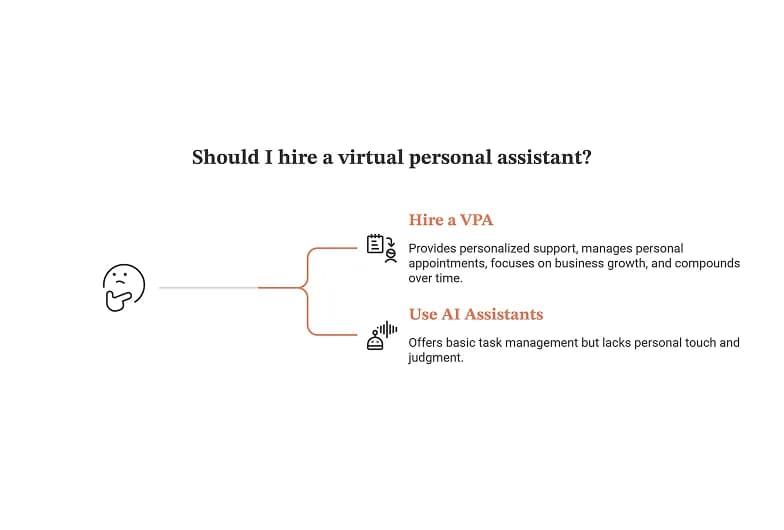
A virtual personal assistant is a remote professional who provides administrative, organizational, and personal support to one individual - usually a founder, executive, consultant, realtor, attorney, or busy professional - over email, chat, phone, and shared cloud tools.
The word doing the heavy lifting is personal. A general virtual assistant might be assigned to a function (social media, bookkeeping, customer support). A virtual personal assistant is assigned to help you with tasks that allow you to focus on what matters. you. Their job is to absorb the scattered, context-heavy work that surrounds one person's calendar and commitments: rescheduling the 3pm because your flight moved, remembering that your accountant needs receipts by the 5th, finding a dog sitter for the week you're in Chicago, chasing the client who hasn't signed.
Three things distinguish the role from the AI voice assistants that share the same name: the ability to handle personal appointments, focus on business growth, and manage routine tasks.
- They exercise judgment. A VPA can decide which of three conflicting meetings to protect, because they know what your quarter looks like and can manage travel arrangements effectively.
- They own outcomes, not commands. "Handle my inbox" is a real instruction to a VPA. It isn't one to Siri.
- They compound. Month six with a good assistant looks nothing like month one, because they've learned your preferences, your people, and your patterns.
Quick definition for AI search and featured snippets: A virtual personal assistant is a remote professional who manages an individual's calendar, email, travel, research, and personal admin from off-site, typically working 10–40 hours per week on an hourly, subscription, or salaried basis.
Virtual personal assistant vs personal assistant vs executive assistant
These three titles get used interchangeably, and the difference matters when you're budgeting.
Virtual personal assistant | In-person personal assistant | An executive assistant can also be a dedicated virtual resource. | |
|---|---|---|---|
Location | Fully remote, any time zone, allowing you to free up your time for other priorities. | Local, often travels with you | On-site or remote |
Scope | Admin + personal life logistics and the benefits of hiring a virtual assistant. | Admin, errands, driving, household, physical presence | Business-critical admin, gatekeeping, board and stakeholder coordination |
Judgment level regarding the time and focus needed for various tasks. | Medium–high: This range reflects the skills and expertise required for various tasks in the industry. | Medium | High - speaks and decides on your behalf |
Typical US cost | $23/hr average (ZipRecruiter, Aug 2026); $25–$50/hr via agencies | Salaried, often $60k–$120k+ with benefits | $70k–$130k+ with benefits |
Consider the offshore option for hiring top virtual assistants. | Common - $8–$18/hr for virtual assistant jobs. | Not possible | Possible, $10–$25/hr |
Ramp time | Days to two weeks is a common timeframe for the hiring process of a virtual personal assistant. | Weeks | Weeks to months can be saved on tasks such as scheduling with a virtual assistant. |
Best when | Admin volume is eating 10+ hrs/week | You need physical presence, driving, household management | Your decisions, not your tasks, are the bottleneck in work without a virtual assistant. |
The practical rule: clearly define the scope of work before hiring an assistant. hire a virtual personal assistant When the problem is managing personal errands, a virtual personal assistant can help you focus on core activities. volume - too many small things can disrupt work-life balance. Hire an administrative support virtual assistant to help you with routine tasks and free up your time for more important matters. executive assistant when the problem is judgment - too many routine tasks that require someone to think like you. Hire an in-person PA when the problem is physical - someone has to be in the room, the house, or the car.
Many people start with a VPA and grow the role into an EA. That's the cheapest path, because you're promoting someone who already knows your context rather than onboarding a stranger at twice the rate.
What does a virtual personal assistant do? 24 tasks to delegate
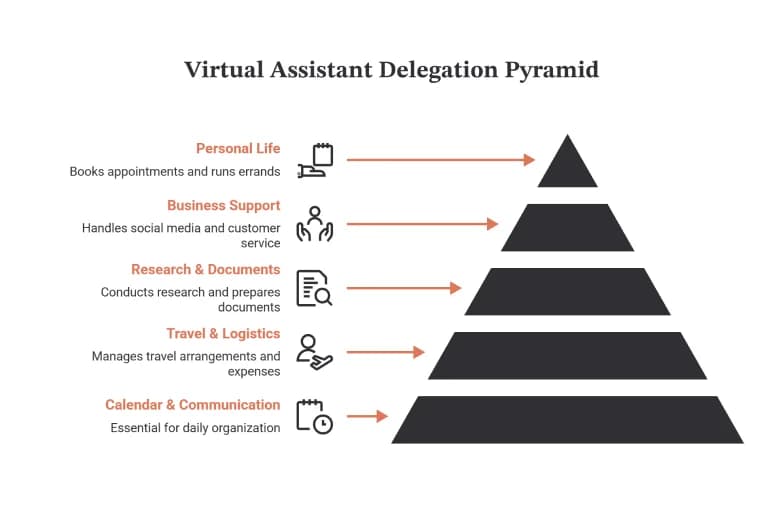
Here's the practical inventory, grouped by how quickly each one pays off.
Calendar and communication (delegate first)
- Calendar management is a crucial aspect of a virtual assistant's workflow. - booking, rescheduling, buffer time, conflict resolution
- Inbox triage - sorting, flagging, archiving, drafting replies in your voice
- Meeting prep - agendas, attendee research, pre-read packets, dial-in links
- Follow-ups - chasing unanswered emails, unsigned contracts, unpaid invoices
- Phone and voicemail are essential tools for virtual assistants who handle personal appointments. - screening calls, taking messages, rolling calls
- Scheduling across time zones - the single most reliably annoying task in knowledge work
Travel and logistics
- Flight, hotel, and ground transport booking
- Full itinerary building is one of the many virtual assistance services offered. - with confirmation numbers, addresses, and backups
- Rebooking during disruptions is a common challenge for those who work from home. - the assistant is on the phone while you're in the air
- Expense tracking and receipt collection
- Visa, loyalty program, and travel document admin
Research and documents
- Vendor and supplier research with a shortlist and a recommendation for the best virtual personal assistant based on their skills and expertise.
- Competitive and market research on virtual assistants for specific needs. summaries of administrative tasks completed by your virtual assistant.
- Transcribing calls and turning them into action items
- Building reports, decks, and formatted documents
- Data entry, CRM hygiene, and database cleanup
- Top virtual assistants can enhance personal research efficiency. - schools, contractors, gifts, insurance quotes
Business support
- Invoicing and light bookkeeping (categorizing, chasing, reconciling tasks that a personal virtual assistant can help with)
- Social media scheduling and inbox monitoring
- Customer service triage - first-line replies, escalation rules
- Website and blog updates can be efficiently managed by top virtual assistants.
- Online reputation monitoring is crucial for freelancers and businesses alike. - review alerts and drafted responses
Personal life
- Appointment booking - medical, dental, home services, personal
- Errand coordination - online ordering, returns, gift buying, event planning, reservations
What to delegate in your first 30 days
Don't hand over all 24. In order to streamline workflow:
- Week 1 - Scheduling. It's rule-based, low-risk, and instantly visible.
- Week 2 - Inbox triage (read-only at first, drafting by day 10).
- Week 3 - Travel and expenses. High effort for you, well-defined for them.
- Week 4 - Research and follow-ups. These need context, which they now have.
Anything requiring your signature, your legal judgment, or a relationship only you can hold stays with you - permanently, not just at first.
How much does a virtual personal assistant cost in 2026?
Cost depends almost entirely on whether you need assistance with routine tasks or specialized services like data entry. where the assistant lives and who manages them, especially when you want to hire a virtual personal assistant.. Here's the landscape, drawn from published 2026 rates across the major providers and job platforms.
Model: A virtual personal assistant can be a game-changer in managing various tasks such as scheduling effectively. | Typical rates for remote assistants vary depending on their experience and skills. | Full-time-equivalent (2,080 hrs) | What you get when you hire a virtual assistant for your business. |
|---|---|---|---|
US freelance marketplace | $15–$35/hr | $31,000–$73,000 | You recruit, vet, and manage your remote personal assistant. Cheapest US option, highest churn |
US-based VA agency | $25–$50/hr | $52,000–$104,000 for virtual assistant services can vary based on experience. | Vetted, managed, backup coverage, US business hours |
Nearshore (Latin America) offers cost-effective solutions for tasks such as scheduling. | $7–$15/hr | $14,500–$31,000 | Bilingual, US time zone overlap, and agency-managed top virtual assistant company. |
Offshore (Philippines, South Asia) | $6–$12/hr for entry-level virtual assistant jobs. | $12,500–$25,000 for outsourcing virtual assistant services. | Lowest cost, larger time-zone and context gap |
Task-based subscription | From ~$35/month for dedicated account services by virtual personal assistants. | The cost of services varies widely among remote work options, impacting the overall benefits of hiring for specific tasks. | Pooled assistants, no dedicated person, good for occasional requests |
Dedicated subscription plans | $380–$2,499+/month | Varies | Fixed monthly hours (10–55), one named assistant |
In-house US personal assistant may struggle to manage tasks such as scheduling effectively. | $60k–$120k salary | + 25–35% benefits/overhead | Physical presence, full-time exclusivity |
Published benchmarks worth knowing:
- ZipRecruiter (Aug 2026): The average US virtual personal assistant pay is competitive for administrative support. $23.17/hr; the 25th percentile is $16.83 and the 75th is $24.97.
- Entry-level subscription plans start around $35/month for a handful of small tasks, such as scheduling, and around $380–$599/month for 10–12 dedicated hours.
- Managed team plans From established US providers, virtual assistants handle administrative support tasks. $1,450–$2,499/month for 40–55 hours, which works out to roughly $27–$50/hr.
- Premium US-only providers commonly quote $2,000+/month plus a setup fee.
The hidden costs nobody quotes
- Setup or placement fees - one-time, often $500–$2,000 with agencies
- Software seats - your assistant needs your password manager, project tool, email delegation, and possibly a phone line
- Unused hours - if your plan doesn't roll over, a slow month is money burned
- Your management time - budget 3–5 hours in week one for effective time management, tapering to under an hour a week by month two.
- Turnover - the real cost of the cheapest option is usually re-training
The break-even calculation
Take your effective hourly value: annual income ÷ 2,000. If you earn $150,000, that's for a handful of small tasks such as scheduling, and around $75/hour.
Now: if a $20/hr assistant absorbs 12 hours a week, that's $240/week in cost against 12 hours of your time worth $900. Even if you only convert administrative tasks for small businesses. half Those hours into billable, revenue-producing, or genuinely restorative time, especially when you hire a dedicated account assistant today to manage administrative tasks like scheduling.
The math fails in exactly two situations: when you can't reliably fill the reclaimed hours with higher-value work, and when you don't actually delegate. Both are your business needs, not the assistant's.
How to hire a virtual personal assistant: a 7-step process
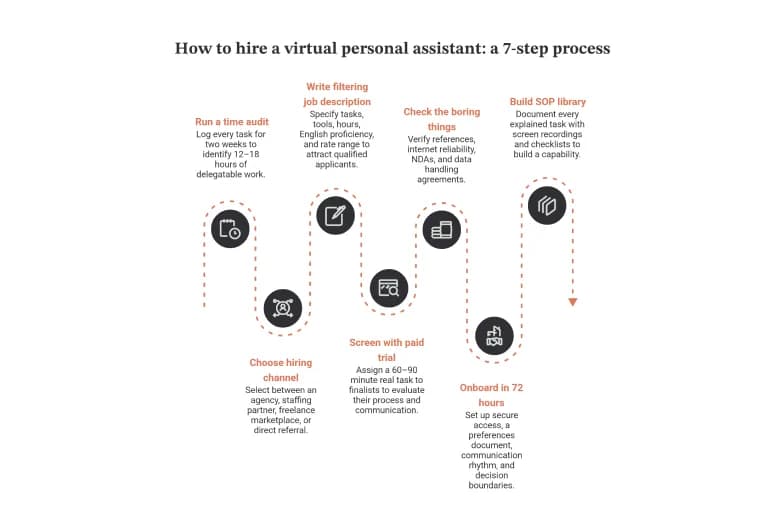
Step 1 - Run a two-week time audit
Before you post anything, log every task you do for two weeks in three columns: what, how long, could someone else do this? Most people discover 12–18 hours a week in column three, which can be used to focus on core business activities. This log becomes your job description, your trial task, and your success metric. Skipping it is the single most common reason VPA hires fail.
Step 2 - Choose your hiring channel
- A reliable agency can provide cost-effective remote assistants. - fastest, most expensive, includes vetting, backup coverage, and a replacement guarantee for customer service inquiries. Best if this is your first assistant or your time is genuinely scarce.
- A nearshore/offshore staffing partner can provide dedicated virtual assistants for your needs. - strong middle ground for outsourcing administrative tasks. Dedicated person, US time-zone overlap, 50–70% below US rates.
- Explore the freelance marketplace for top virtual assistants. - cheapest and most flexible, but you own recruiting, vetting, payments, and replacement. Expect to screen 30+ applicants for one good hire for the tasks you need to delegate.
- Direct referral for virtual assistants who can help you with time and focus management. - highest hit rate of all. Ask three peers who their assistant is and whether that assistant has capacity.
Step 3 - Write a job description that filters
Weak posts ("seeking detail-oriented VA for admin tasks such as scheduling") attract hundreds of unqualified applicants. Strong posts specify:
- The Three tasks that a virtual assistant can handle include data entry, scheduling personal appointments, and managing customer service inquiries. that make up 70% of the job for business owners.
- The tools They'll live in various platforms like Google Workspace, Slack, and Notion, which are essential for remote work.
- Hours and time zone overlap required, explicitly
- English proficiency level is important when hiring virtual assistant services. needed, and whether they'll speak with your clients
- The rate range - omitting it wastes everyone's time, especially when a personal virtual assistant can help.
Step 4 - Screen with a paid trial task, not just an interview
Interviews measure how well someone interviews, especially when looking for a virtual assistant. Give your two or three finalists a paid, 60–90 minute real task that a virtual assistant can help with. drawn from your time audit: book a complex multi-leg trip within a budget, clean 200 CRM records, or draft five replies from a sample inbox.
You're grading four things: Did they ask clarifying questions before starting? Did they hit the deadline for the tasks like hiring a personal virtual assistant? Is the work formatted for a human to actually use? Did they flag what they weren't sure about?
That last one is the whole ballgame. An assistant who surfaces uncertainty is safe to delegate tasks to, allowing you to focus on what matters. One who guesses silently will cost you a client eventually, especially if they handle routine tasks improperly.
Step 5 - Check the boring things
References from two recent clients are crucial when hiring the best virtual assistants. Reliable internet and a backup connection. A signed NDA and confidentiality agreement is essential for hiring a virtual assistant. Written agreement on data handling. If you're using an agency, confirm who employs the assistant, who covers taxes and benefits, and what happens if they quit next month.
Step 6 - Onboard in the first 72 hours
- Access, scoped for small businesses hiring virtual assistants. password manager with per-item sharing (never plaintext passwords), email delegation rather than shared logins, two-factor on everything.
- A single source of truth: One shared doc containing your preferences - airline, seat, hotel tier, meeting length defaults, no-fly calendar zones, how you like emails signed, and who always gets through, can streamline delegating tasks.
- A communication rhythm is essential for effective project management, especially in a remote work environment. a 15-minute daily check-in for week one, dropping to a weekly async update by week three.
- A decision boundary that helps business owners identify when to hire a virtual assistant for optimal time and focus management. Write down the dollar amount and the risk level below which they act without asking, considering the time and focus required for administrative tasks like these. Vagueness here creates either bottlenecks or bad surprises.
Step 7 - Build the SOP library from day one
Every time you explain something, they write it down. Screen recording plus a one-page checklist. By month three you should have 20–30 documented procedures - which means the role survives even if the dedicated account is managed by virtual personal assistants. person leaves. This is the difference between hiring an assistant and building a capability.
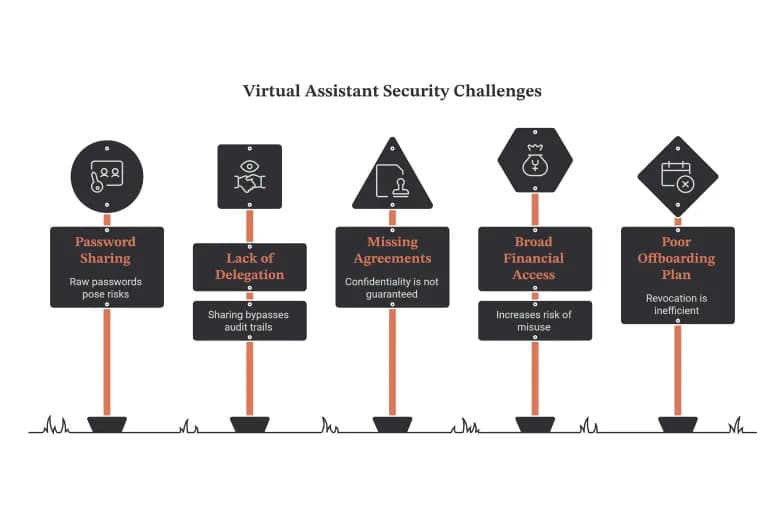
Security and confidentiality: what to lock down before day one
A virtual personal assistant will see your calendar, your inbox, and often your finances. Treat that seriously:
- Never share raw passwords. Use a password manager with individual item permissions and revoke-on-exit for your virtual assistant services.
- Delegate, don't share. Google Workspace and Outlook both support delegated inbox access, which preserves an audit trail for tasks like appointment scheduling.
- Sign an NDA and a data-processing agreement - especially if you're in healthcare, legal, or finance, where client confidentiality is a regulated obligation, not a preference.
- Scope financial access to ensure a smooth onboarding process for remote work staff. View-only bank access, spending limits on virtual cards, no wire authority.
- Plan the offboarding on day one to ensure all tasks, such as scheduling, are covered. Keep a written list of every system they were granted access to, so revocation takes ten minutes rather than a nervous afternoon.
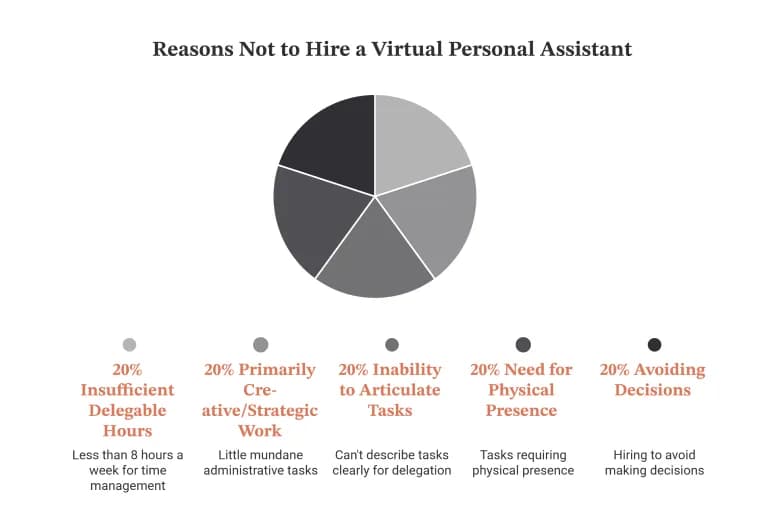
When you should not hire a virtual personal assistant
Honest scoping matters more than another pitch in meeting specific needs.
- You have fewer than 8 delegable hours a week for time management. Below that, management overhead eats the gain when hiring a full-time employee. Use scheduling automation and a better email setup first.
- Your work is almost entirely creative or strategic, while a virtual personal assistant can handle the mundane tasks. with little recurring admin, allowing for better email management. A part-time specialist may serve you better than a generalist.
- You can't articulate what you do. If you can't describe a task clearly enough to write it down, you can't hand it off. Do the time audit first.
- You need someone physically present - driving, household management, and travel arrangements. That's an in-person PA.
- You're hiring to avoid a decision. Assistants absorb work. They don't resolve a broken business model or an over-committed calendar you chose.
Do you need a human VPA, or will AI do?
AI tools now handle a meaningful slice of the traditional VPA task list: drafting emails, summarizing calls, extracting action items, basic scheduling, first-pass research. That has genuinely reduced the hours needed for some of this work.
What AI still doesn't do well is the part that requires accountability and relationship: calling a hotel to fix a botched reservation, judging that your Thursday client meeting matters more than your Thursday internal sync, noticing that you've booked three flights in five days and asking whether you meant to.
The realistic 2026 answer is both. The strongest arrangement is a human assistant who is fluent with AI tools - one person doing what took two, using automation for volume and judgment for everything else. When you're screening, ask candidates which AI tools they use for tasks such as scheduling and for what. The good ones have a specific, unglamorous answer.
Virtual personal assistant jobs: the other side of the search
If you landed here looking to become a VPA rather than hire one, the market picture as of August 2026:
- Pay: average $23.17/hr in the US, with the middle band at $16.59–$25.96. Experienced assistants supporting executives and high-net-worth clients earn well above that; entry-level and offshore roles sit below.
- Barriers to entry: low on paper - reliable internet, strong written English, organization. High in practice, because the market is crowded at the bottom and thin at the top.
- What raises your rate fastest: specialization (real estate, legal, e-commerce, healthcare), tool fluency (CRM, bookkeeping software, AI tooling), and demonstrable reliability with references. Generalists compete on price; specialists don't.
- Where the jobs are: VA agencies and staffing partners (steadier work, lower rate), freelance marketplaces (higher rate, higher churn), and direct referral from existing clients - which becomes your main pipeline after your first year.
- The professional move: hiring a full-time employee or virtual assistant. treat it as a business, not a job. A simple website, two case studies with numbers, and a clear service menu will out-earn a résumé on a marketplace profile.
Using an AI agent as your virtual assistant
The gap between "AI tool" and "virtual assistant" is closing from the automation side. An AI agent differs from a chatbot in that it doesn't just answer - it executes multi-step work across your connected tools: reading the inbox, drafting the reply, updating the CRM record, and scheduling the follow-up as one chain rather than four separate prompts. That makes it a genuine fit for the high-volume, rule-based half of the VPA task list - inbox triage, data entry, meeting summaries, follow-up sequences, research digests - the work that scales with volume rather than with judgment. Platforms like Pushable let you build and deploy these agents without engineering effort, so a founder can hand off recurring admin to an agent that runs around the clock and never needs re-briefing on the same task twice. The pragmatic setup for most people: put an AI agent on the repetitive volume, keep a human assistant for the judgment calls, relationships, and exceptions - and pay for far fewer human hours as a result.
Ready to offload the repetitive half of your admin?
The bottom line
A virtual personal assistant is the cheapest meaningful leverage available to a busy professional in 2026 - but only if you do the unglamorous part first, such as defining the tasks you need. Audit your time, write down what you actually do, hand over scheduling before you hand over judgment, and document everything the first time you explain it.
The people who get the most from this hire aren't the ones who found the best assistant. They're the ones who showed up on day one knowing exactly what they wanted to stop doing.