


SEO Audit Services in 2026: What They Cost, What's Included, and Why AI Agents Are Changing the Game
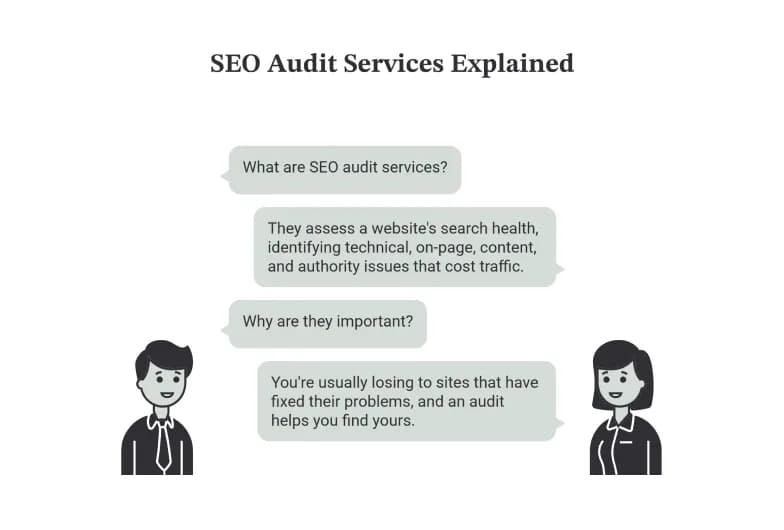
SEO audit services are professional (or software driven) assessments of a website's search health they crawl your site, cross check it against how Google actually ranks pages, and hand back a prioritized list of the technical, on page, content, and authority issues that are quietly costing you traffic. In plain terms: you're usually not losing to better websites, you're losing to sites that already found and fixed their problems. An audit is how you find yours.
The catch nobody puts on the sales pageAn audit is a photograph, and your website is a video. A report that's accurate the day it's delivered can be stale a month later a template ships, a redirect stacks up, a plugin breaks a tag, a competitor publishes something better. This guide covers what SEO audit services include, what they cost in 2026, and how a new category always on AI audit agents like Pushable turns the one time PDF into a living system that never stops watching.
What are SEO audit services?
An SEO audit service is a structured evaluation of everything that affects your organic search performance, delivered as findings plus a fix plan. Depending on the provider, "SEO audit services" can mean any of three very different things:
- A done for you agency engagement human experts manually review your site over several weeks and deliver a report, a strategy call, and a roadmap.
- A DIY audit tool software (like SEOptimer, Screaming Frog, Ahrefs, or Semrush) that scans your site and generates a score and issue list you interpret yourself.
- An automated audit agent an AI system that runs the audit workflow continuously, monitors for regressions, and routes fixes for approval, rather than producing a single snapshot.
All three answer the same underlying question what is stopping this site from ranking, and what should we do first? but they differ enormously in depth, cost, speed, and how quickly the findings go out of date.
What's included in a professional SEO audit
A comprehensive audit looks at your site as one connected system, not a checklist of isolated errors. Here's the standard scope you should expect from any serious SEO audit service:
Audit layer | What it checks | Why it matters |
|---|---|---|
Technical SEO | Crawlability, indexation, robots.txt, canonicals, sitemaps, redirects, site architecture, Core Web Vitals (LCP, INP, CLS), mobile rendering | If Googlebot can't reach or render a page cleanly, nothing else you do matters |
On page SEO | Title tags, meta descriptions, H1–H3 hierarchy, internal links, anchor text, image alt text, schema markup | Where search intent, page structure, and buyer behavior meet |
Content | Thin pages, keyword cannibalization, decaying posts, topical gaps, outdated information | Names which URLs to refresh, consolidate, redirect, expand, or leave alone |
Keyword mapping | Search demand vs. current rankings, page intent, one best fit URL per priority term | Stops multiple pages from competing for the same query |
Off page / backlinks | Referring domains, anchor profile, toxic links, competitor link gaps, lost links | Separates useful authority from spammy noise that drags you down |
Analytics & tracking | GA4 events, ecommerce/lead tracking, attribution, dashboard accuracy | Bad measurement means budget decisions made from bad data |
Competitor & SERP gaps | The pages actually taking your rankings, snippets, and AI answer placements | Your real competitors are SERP defined, not the brands named in meetings |
AI visibility (GEO) | Whether ChatGPT, Perplexity, Google AI Overviews, and AI Mode can read and cite your pages | AI search is now a standalone visibility channel, not an afterthought |
That last row is the newest addition. Google's own guidance is blunt about it: "AEO" and "GEO" are rebranded labels for SEO AI Overviews and AI Mode are grounded in the same ranking and quality systems as classic Search. You don't need special AI files or markup; you need clean structure, quotable statements, clear attribution, and freshness. A modern audit should flag where your pages fail those signals, because roughly a quarter of the content on an average site never even loads for AI crawlers.
The three types of SEO audit services, compared
Choosing an SEO audit service is really about choosing a model. Each has a distinct trade off between depth, cost, and how long the findings stay useful.
Agency audit | DIY audit tool | AI audit agent | |
|---|---|---|---|
Best for | Complex, high stakes, or enterprise sites | Small sites, quick checks, tight budgets | Teams that want auditing to be continuous, not annual |
Depth | Very high (human judgment) | Shallow to moderate | Moderate to high (depends on connected data) |
Turnaround | 3–5 weeks | Minutes | Runs on a schedule, always on |
Typical cost | $500–$10,000+ per audit | $0–$100/mo | Usage based (pay per task completed) |
Goes stale? | Yes a snapshot | Yes you must re run it | No monitors continuously |
Fixes the issues? | Sometimes (extra scope) | No you interpret and act | Drafts and routes fixes for human approval |
Human expertise | Deep, built in | None | Human in the loop by design |
There's no universally "best" option the right one depends on your site's complexity, your team, and your budget. A one time expert agency audit is genuinely worth it for a migration, a traffic collapse, or an enterprise ecommerce build. A free tool is fine for a five page brochure site. But for most growing businesses, the expensive gap is the same one an established agency (OuterBox) admits on its own page: audits age quickly when no one owns the fixes. That's the gap the AI agent model is built to close.
How much do SEO audit services cost in 2026?
Pricing varies widely by site size, depth, and whether implementation is included. Based on published 2026 rates across the providers in this space, here's the realistic range:
Service level | Typical price | What you get |
|---|---|---|
Free automated scan | $0 | Crawl of core pages, broken links, meta/H1 issues, PageSpeed score |
Entry / "mini" audit | $500–$750 | Technical + on page fundamentals, issue list |
Standard professional audit | $1,100–$2,700 per audit | Full technical, on page, content, and backlink review roadmap |
Enterprise / ecommerce audit | $5,000–$10,000+ per audit | Deep platform specific analysis, analytics validation, strategist calls |
Ongoing enterprise SEO (with audits) | $5,000–$25,000+/month | Continuous program including audits, fixes, and reporting |
For context, most US agencies bill SEO at $100–$250 per hour. The important nuance: price mostly reflects human hours and site complexity, not audit quality per dollar. A $1,500 flat rate audit with a clear roadmap can be more useful to a mid size brand than a $9,000 enterprise engagement is to a small business that can't act on it.
A quick honesty note, straight from Google: no tool or service can guarantee rankings, and third party tools have no access to Google's internal ranking data. Any "SEO score" from an agency, a scanner, or an AI agent is a heuristic, not a signal from Google. Search Console is your first party source of truth. Treat every audit as a prioritized hypothesis, not gospel.
How often should you run an SEO audit?
The conventional answer is "a comprehensive audit a few times a year, plus lightweight technical checks monthly." That advice made sense when SEO changed slowly. It doesn't anymore.
Google now ships continuous, smaller, unannounced core updates between the big named ones. Helpfulness signals are weighted into every update rather than enforced through separate events. Your competitors publish weekly. Your own team pushes template changes, new products, and third party scripts constantly. In that environment, an annual or quarterly audit means you're finding out about a regression weeks or months after it cost you traffic.
This is the structural weakness of the traditional SEO audit service, agency or tool alike: it produces a snapshot on a cadence, and reality drifts in between. The fix isn't a better snapshot. It's changing the cadence to continuous.
The shift: from one time audits to always on AI audit agents
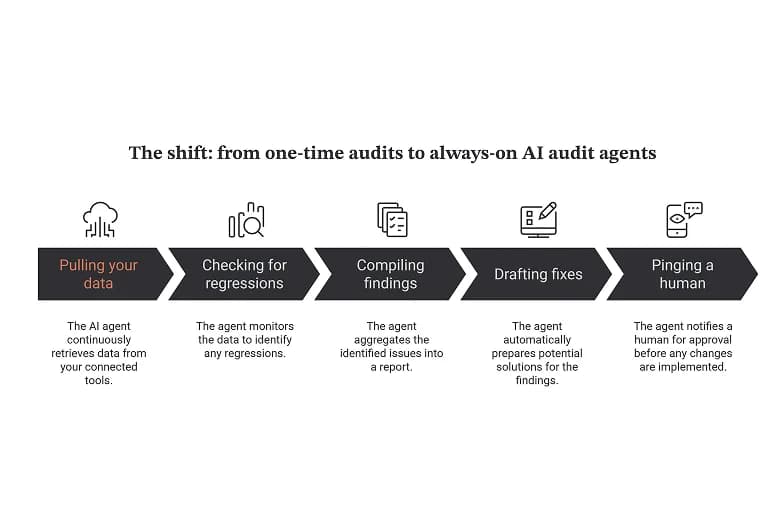
Here's where the model genuinely changes. Instead of paying for an audit event, you deploy an AI agent that runs the audit workflow on a schedule and never stops pulling your data, checking for regressions, compiling findings, drafting fixes, and pinging a human before anything changes.
This is exactly what Pushable is built for. Pushable is a shared AI workspace where teams deploy agents that run multi step workflows around the clock on schedules and event triggers, even when no one has the app open. It connects to 100+ tools you already use (Google Sheets, Search Console data exports, GA4, your CMS, Slack, Jira, Asana, Notion) and keeps a human in control through approval gates and one tap Telegram approvals before any action ships.
That combination continuous execution + real business context + human sign off is what a one time audit can't offer. It's the difference between "here's a report" and "your audit is a system that's watching your site right now."
What an SEO audit agent actually does day to day
A Pushable agent built for SEO auditing runs a loop like this, on whatever schedule you set:
- Pulls the data. It reads your latest exports and connected sources Search Console performance, GA4 traffic, crawl data, ranking exports from the Google Sheets and tools where they already live.
- Compares against last run. It looks for what changed: sudden traffic drops on key URLs, new crawl or indexation errors, broken internal links, Core Web Vitals regressions, lost rankings, or pages that just fell out of the index.
- Compiles prioritized findings. Instead of a 200 line dump, it surfaces the handful of issues that actually moved, ordered by likely impact the "what to fix first" that a static report leaves your team to figure out.
- Drafts the fix and waits. For actionable items (a missing meta description, a broken redirect, a thin page that needs expansion) it drafts the change or opens a ticket, then pauses for human approval on Telegram or Slack. Nothing goes live without a person tapping "approve."
- Reports on a cadence. It files a weekly plain English summary to your channel of choice, so leadership sees trendlines, not noise.
Because Pushable charges by completed task (credits are only spent when the agent actually finishes work), you're not paying a monthly retainer for a site that's healthy this week you're paying for the checks and fixes that actually run.
Be clear eyed about scope. Pushable is the orchestration, monitoring, and execution layer it ties your audit data, your tools, and your fixes into a continuous, human approved loop. It's not a replacement for a deep one time expert diagnosis on a complex migration, and for heavy crawl analysis it works best fed by data from dedicated crawlers. The point isn't to eliminate expertise. It's to make sure the day to day drift between big audits never goes unwatched.
How to choose the right SEO audit approach
Match the model to your situation rather than defaulting to the most expensive option:
- Choose a human agency audit if you're mid migration, recovering from a traffic collapse, or running a complex enterprise/ecommerce stack where judgment beats automation. Look for a fixed scope, a prioritized roadmap with owners, and a follow up review not just a PDF.
- Choose a DIY tool if you have a small, simple site and the in house skill to act on a raw issue list.
- Choose an AI audit agent (like Pushable) if your real problem is continuity you've had audits before, the findings went stale, and nobody was watching between them. This is the model for teams that want auditing to run every week, not every quarter.
- Best of both: commission a deep expert audit once, then hand the ongoing monitoring and routine fixes to an AI agent so the expensive findings never rot.
SEO audit checklist (quick reference)
Use this whether you're auditing yourself or evaluating a provider's scope:
- Site is crawlable and indexable (robots.txt, meta robots, canonicals, sitemaps aligned)
- No redirect chains, orphan pages, or index bloat from parameters
- Core Web Vitals pass on your key templates (LCP ≤ 2.5s, INP ≤ 200ms, CLS ≤ 0.1)
- Mobile rendering shows the same content as desktop
- Titles, meta descriptions, and H1s match search intent and aren't truncated
- One best fit URL per priority keyword (no cannibalization)
- Thin, duplicate, and decaying content is flagged for action
- Internal links point authority to your money pages with descriptive anchors
- Backlink profile is free of toxic links; competitor gaps are mapped
- GA4 and conversion tracking fire correctly (purchase, add_to_cart, lead events)
- Content is quotable and well structured for AI Overviews and AI Mode
- There's an owner and a cadence for re checking all of the above
That last item is the one most audits skip and the one that determines whether any of the others stay fixed.
Stop auditing your site once a year. Start watching it every week.
A traditional SEO audit service tells you what was broken on the day it looked. That's valuable once. But rankings are lost in the weeks between audits, when no one's watching. The teams pulling ahead in 2026 aren't the ones buying more reports; they're the ones who turned auditing into a continuous, automated loop with a human at the controls.
That's what Pushable makes possible: deploy an AI agent that audits your site around the clock, flags what changed, drafts the fixes, and waits for your one tap approval so problems get caught and handled before they cost you traffic.
Build your SEO audit agent on Pushable → Start free, and only pay when the work actually gets done.
This article explains general SEO audit concepts and pricing ranges observed across the industry in 2026. Audit scores and tool outputs are heuristics, not signals from Google; validate findings against Google Search Console and official Google Search documentation.