
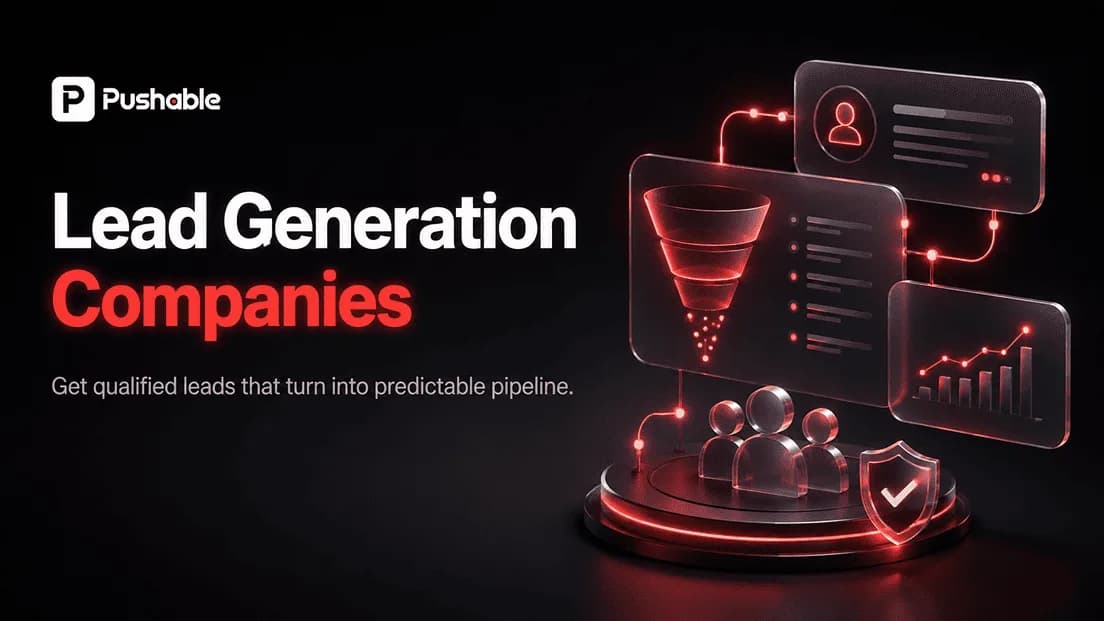
Lead Generation Companies: The Complete 2026 Guide (and the AI Alternative Changing the Game)
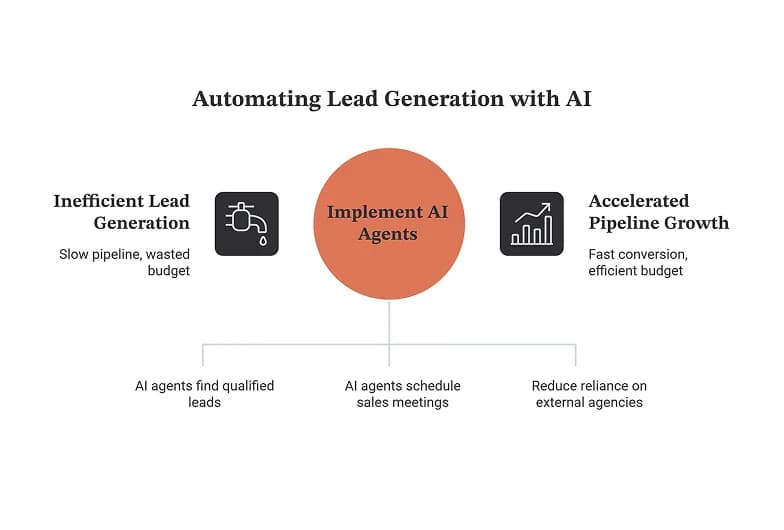
Lead generation companies are agencies and platforms that find, qualify, and deliver potential customers to your sales team so your reps can focus on closing instead of prospecting. Some run outbound campaigns and book meetings for you. Others sell contact data, run paid ads, or generate inbound demand through content. The right one can fill your pipeline fast the wrong one can burn budget on leads that never convert.
This guide breaks down what these companies actually do, the main types, the providers worth knowing in 2026, and how to choose one without regret. It also covers a shift that's reshaping the category: instead of outsourcing lead generation, a growing number of teams now automate it in house with AI agents. We'll show you where a platform like Pushable fits, and where a traditional agency still wins.
What Do Lead Generation Companies Actually Do?
At the core, a lead generation company takes the top of funnel work off your plate. Instead of your team cold calling, cold emailing, scraping lists, and chasing form fills, an external partner handles some or all of that motion.
Most providers deliver one or more of the following:
- Prospect research and data building targeted lists of accounts and contacts that match your ideal customer profile (ICP).
- Outbound outreach cold email, cold calling, and LinkedIn messaging at scale.
- Appointment setting booking qualified sales meetings directly onto your reps' calendars.
- Inbound and demand generation content, SEO, paid media, and webinars that pull prospects toward you.
- Lead qualification filtering raw interest into sales ready leads (often using BANT, MEDDIC, or a custom scoring model).
- Reporting and attribution showing which channels and campaigns produced pipeline and revenue.
The value proposition is simple: you get expertise, data, and capacity without hiring, training, and managing an in house SDR team.
Why teams hire them
There are three recurring reasons companies outsource lead gen:
- Freeing up internal resources. Your team stays focused on product, service, and closing while a partner handles the grind of prospecting.
- Buying expertise fast. A good agency already knows which channels your buyers use and how to reach them, which shortcuts months of trial and error.
- Scaling reach. Agencies can ramp campaigns up or down and often bring proprietary data that's useful for entering new markets or geographies.
These are real benefits. They're also the exact benefits AI automation now delivers differently more on that below.
The Main Types of Lead Generation Companies
"Lead generation company" is a broad label. Under it sit several distinct models, and knowing the difference saves you from paying for the wrong thing.
Type | What they do | Best for |
|---|---|---|
B2B appointment setting / SDR agencies | Run outbound and book meetings on your calendar | Companies with a strong close rate that need more at bats |
Data & sales intelligence providers | Sell verified contact and company data, intent signals | Teams that run outreach in house but need better lists |
Demand generation agencies | Content, SEO, paid media, webinars to drive inbound | Brands building long term, compounding pipeline |
LinkedIn & social lead gen | Outreach and ads focused on LinkedIn | B2B teams whose buyers live on LinkedIn |
Content syndication providers | Distribute gated assets to generate MQLs at volume | Enterprise marketing teams with lead quotas |
PPC / performance agencies | Paid search and social optimized for lead volume | Teams that can convert paid traffic efficiently |
AI automation platforms | Software + AI agents that run lead gen workflows for you | Teams that want to own the process and cut per lead cost |
Most agencies blend two or three of these. The last row is the newest category and the one this guide argues you should evaluate seriously before signing a long agency contract.
Top Lead Generation Companies to Know in 2026
The providers below appear consistently across industry roundups and review sites. This isn't a ranking the "best" choice depends entirely on your model, budget, and market. Treat it as a shortlist to research, and always validate current pricing and reviews directly, since agency reputations and rosters change.
- Belkins a widely recognized B2B appointment setting agency known for outbound campaigns and lead quality. Generally positioned as a premium option, so it fits companies with the budget and close rate to justify the spend.
- SalesRoad (SalesRoads) outsourced SDR and appointment setting with a reputation for tailored sales playbooks; often cited as a fit across SMB through enterprise.
- CallBox a multi channel, full funnel provider spanning outbound, webinars, and events rather than a single channel.
- Martal Group outbound lead gen and sales enablement that has increasingly leaned into AI assisted prospecting for higher intent leads.
- Cleverly specializes in LinkedIn driven lead generation and cold outreach, with pricing that scales widely by scope.
- ZoomInfo best known as a sales intelligence and data platform; strong when your team runs outreach in house but needs accurate contact and intent data.
- SalesBread, MarketJoy, and similar boutique agencies done for you outbound and appointment setting, often with per lead or per meeting guarantees worth scrutinizing.
When you read vendor roundups (including this one), remember the honest caveat: no third party list has access to your actual conversion data, and "best" is always relative to your situation. Verify claims against first party sources case studies, references, and a paid pilot before committing budget.
How to Choose the Right Lead Generation Company
Picking a partner is a high stakes decision. A strong one accelerates growth; a weak one sets you back months. Use this checklist:
- Quality over quantity. Ask how they define a "qualified" lead and how many convert to opportunities not just how many leads they deliver.
- Transparency. They should explain their process, data sources, and outreach methods clearly, without hiding behind jargon.
- ICP alignment. Can they show experience with your industry, deal size, and buyer? Generic outreach to the wrong list wastes everyone's time.
- Attribution and reporting. You need to see which activities produce pipeline, not just a vanity dashboard of "leads generated."
- Pricing model fit. Retainer, pay per lead, and pay per meeting each carry different incentives. Understand what you're really paying for and what happens to lead quality under each.
- Compliance. Confirm they respect GDPR, CAN SPAM, and data privacy rules sloppy outreach can damage your domain reputation and brand.
- Exit terms. Short pilots beat long lock ins. Test before you commit.
Run a small paid pilot first. Any confident provider will accept one.
The Hidden Trade offs of Outsourced Lead Generation
Agencies solve real problems, but they come with structural limitations that are worth naming honestly:
- You don't own the engine. When the contract ends, the playbooks, data workflows, and momentum often leave with the agency.
- Cost scales with volume. More leads usually means a bigger retainer the economics rarely improve as you grow.
- Lead quality is variable. Pay per lead models can incentivize volume over fit, and your team ends up filtering noise.
- Slow feedback loops. Changes to targeting or messaging can take days or weeks to reach the field.
- Limited context. An external team rarely knows your product, tools, and history the way your own systems do.
None of this makes agencies a bad choice. But it explains why many teams are now asking a different question: what if we could own the lead generation process ourselves without hiring an army of SDRs?
That's where AI automation enters.
The Shift: AI Powered, In House Lead Generation
For years, the only way to scale lead gen without hiring was to outsource it. AI has changed the math.
Modern AI agents can now handle the repetitive, high volume work that used to require a team of SDRs and ops people: enriching a new lead, checking it against your ICP, routing it to the right rep, and drafting a personalized first touch message automatically, around the clock. Instead of renting a lead generation function, you can build one that lives inside your own tools and improves over time.
This isn't about replacing salespeople. It's about removing the manual busywork between "a lead arrives" and "a human has a real conversation" the exact gap where most inbound interest goes cold.
The key advantages of an in house AI approach:
- You own the workflow. The logic, data, and playbooks stay in your company, not an agency's account.
- Speed to lead in minutes. Automated enrichment and routing mean prospects get a relevant reply while they're still interested.
- Cost decoupled from headcount. You pay for tasks completed, not per seat or per lead.
- Full context. Agents act on your real CRM, inbox, and data not a blank slate.
- Always on. Work continues on nights and weekends, not just during agency business hours.
How Pushable Turns Lead Generation Into an Automated Workflow
Pushable is a shared AI workspace where teams deploy AI agents to run business workflows including the entire top of the sales funnel. Rather than outsourcing lead gen to an agency, you configure agents that execute it inside your own connected tools.
Here's what that looks like for a sales team, using Pushable's own described sales workflow: every form fill becomes a conversation in minutes, not days. An agent can qualify an inbound lead, enrich it with additional data, route it to the right rep, and draft a first touch follow up the moment the lead arrives.
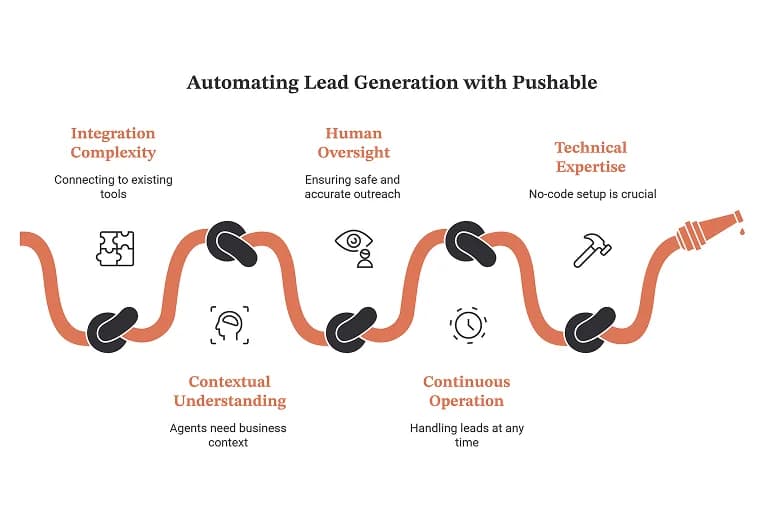
What makes this practical for real go to market teams:
- 100+ native integrations, plus custom MCP connectors. Agents read and write to the systems you already use HubSpot, Salesforce, Gmail, Slack, Google Sheets, and more so leads flow through your actual stack.
- Team native shared workspace. Shared memory, files, databases, and permissions mean every agent is grounded in your real business context, not an isolated chat session.
- Human in the loop approvals. Approval gates pause an agent mid task, and Telegram based notify and approve flows let a human sign off before anything reaches a prospect. Automation stays safe enough for real outreach.
- Cloud native and always on. Agents run continuously on schedules and event triggers a new lead at 2 a.m. still gets enriched, routed, and queued for follow up.
- No code setup. You build workflows through a UI and deploy pre trained agents in minutes, without an engineering project.
A simple AI lead gen workflow you can build
A typical inbound lead automation in Pushable might run like this:
- Trigger: A prospect submits a form or lands in your CRM.
- Enrich: The agent appends firmographic and contact data.
- Qualify: It scores the lead against your ICP rules.
- Route: It assigns the lead to the right rep or territory.
- Draft: It writes a personalized first touch email or message.
- Approve: A human approves the send via Telegram in one tap.
- Log: Everything is written back to your CRM automatically.
The whole loop can run in minutes and because it lives in your workspace, it gets more refined as your team tunes it.
Pricing that scales with results, not headcount
Pushable uses a credit based model: credits are spent only when an agent actually completes a task a message sent, a lead routed, a report filed not for every user who logs in. Plans start with a free tier (200 credits/month) and move up through paid tiers for teams running serious volume, with custom enterprise options. Because there are no per seat fees, the whole team can use it without the bill growing with headcount. (Check the Pushable pricing page for current plans and limits, as pricing can change.)
Lead Generation Company vs. AI Automation Platform: Which Should You Choose?
Factor | Traditional lead gen company | AI automation platform (e.g., Pushable) |
|---|---|---|
Ownership | Agency owns the process and playbooks | You own the workflow and data |
Cost model | Retainer or per lead; scales with volume | Pay per task completed; decoupled from headcount |
Speed to lead | Hours to days | Minutes, 24/7 |
Context | External, limited product knowledge | Grounded in your CRM, inbox, and data |
Control | Depends on the vendor | Human in the loop approvals on every action |
Setup effort | Low they run it | Low–medium you configure agents (no code) |
Best when | You want hands off, human led outreach at scale | You want to own an efficient, always on engine |
When an agency still makes sense
Outsourcing is the right call when you need seasoned human SDRs making nuanced, high touch calls into enterprise accounts, when you're entering a market where an agency's relationships and data give a real edge, or when you simply want the function fully off your plate and have the budget for it.
When AI automation wins
Choose the in house AI route when speed to lead matters, when you want to own the process and cut per lead cost, when you already have decent inbound or data but leads slip through the cracks, or when you want your team focused on closing rather than manual prospecting admin.
The best answer is often "both"
Many teams run agency outbound for high value accounts and use an AI platform to instantly handle inbound, enrichment, and routing. The two aren't mutually exclusive and combining them often produces the strongest pipeline.
The Bottom Line
Lead generation companies exist to fill your pipeline so your team can sell. They range from B2B appointment setting agencies and data providers to demand gen shops and, increasingly, AI automation platforms. The traditional agency route is proven and hands off, but you rent the engine and cost scales with volume.
AI automation flips that model. With a platform like Pushable, you build an always on lead generation workflow inside your own tools one that qualifies, enriches, routes, and follows up in minutes, with a human approving every action and costs tied to results instead of seats.
If you're evaluating agencies, get quotes and run a pilot. But before you sign a long contract, it's worth asking whether you could own the engine instead.
Start building your AI lead generation engine free with Pushable →