
Human Resources Software in 2026: Why Your HR Team Needs a System of Action, Not Just a System of Record
Last updated: August 2026
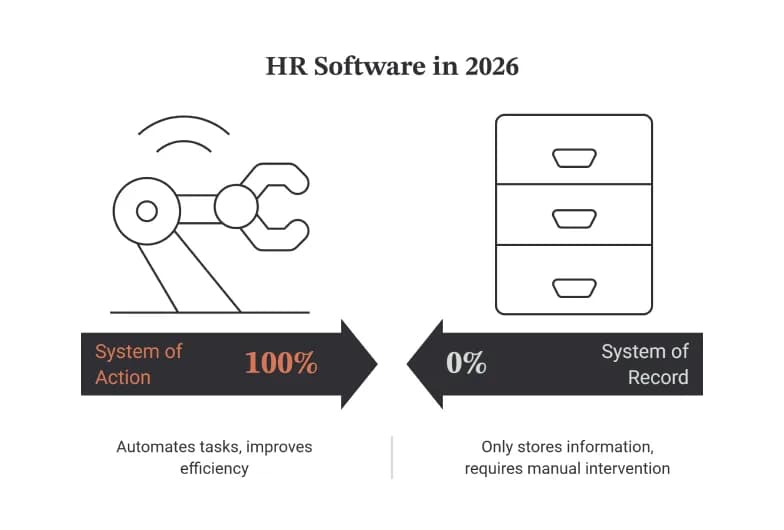
Most Human Resources software was built to hold information: employee records, PTO balances, org charts, review notes. That was revolutionary in 2005. In 2026, it's the bare minimum. Your HRIS knows that Priya requested three days off. It just won't route the request, check the coverage, update the calendar, notify her manager, and confirm back to Priya. Someone on your team still does all of that by hand.
That gap, between software that stores work and software that does work, is the single biggest opportunity in HR technology right now. This guide breaks down what modern Human Resources software actually needs to do, where the traditional tools stop short, and how an AI automation layer like Pushable turns your HR stack from a filing cabinet into a workforce.
What Human Resources Software Actually Does (and Where It Stops)
At its core, Human Resources software is any digital platform that helps organizations manage the employee lifecycle: hiring, onboarding, payroll, time off, performance, compliance, and offboarding. The category spans a few familiar shapes:
- Free and lightweight HR tools that give small teams a basic system of record for employee data and leave.
- All in one HRIS and HCM platforms that bundle onboarding, attendance, performance, and payroll into one suite.
- Specialist point solutions for employee relations, investigations, applicant tracking, or learning.
- Roundup "best of" lists that help you pick between the above.
Every one of these categories solves a real problem. But notice the common thread: they are almost all systems of record. They give you a clean place to enter, view, and report on HR data. The actual execution (the chasing, routing, reminding, updating, and following up) still lands on a human being.
And that human is drowning. HR workloads keep climbing while headcount barely moves, which is exactly why automation has shifted from experiment to necessity across onboarding, payroll, learning, and performance management. The tools captured the data. They never took over the work.
The 2026 Reality: HR Is Becoming an AI First Function
The numbers make the direction unmistakable. According to recent industry research, 85% of employers using HR automation or AI report time savings and efficiency gains, and AI can shrink the pile of applications HR has to manually review down to a fraction of the original volume. Adoption is accelerating fast: by 2026, over 80% of HR departments are expected to use generative AI or predictive analytics in daily operations, and 62% of HR professionals believe AI can help them hire the best person for the job.
The most important shift isn't chatbots, though: it's agentic AI, software that doesn't just answer questions but takes multi step action on your behalf. Gartner predicts that by 2028, 33% of enterprise software applications will include agentic AI, up from less than 1% in 2024, with organizations already using it to automate onboarding, simplify payroll validations, and generate insights from HCM data.
Here's the catch: most companies are nowhere near ready to capture that value. Nearly 6 in 10 employers underutilize the HR information system they already pay for, and AI adoption skews heavily toward large enterprises: roughly 38% of large enterprises use AI in HR versus only 22% of small organizations. The tools exist. The execution layer that makes them actually do something for a lean team is what's missing.
That execution layer is exactly what Pushable was built to be.
Where Pushable Fits: The AI Automation Layer for HR
Pushable is a shared AI workspace where your team deploys AI agents that run real HR workflows around the clock, with shared business context, one tap human approvals, and the tools you already use plugged in. It doesn't replace your HRIS, your ATS, or your payroll provider. It sits on top of them and finally does the work they were never designed to do.
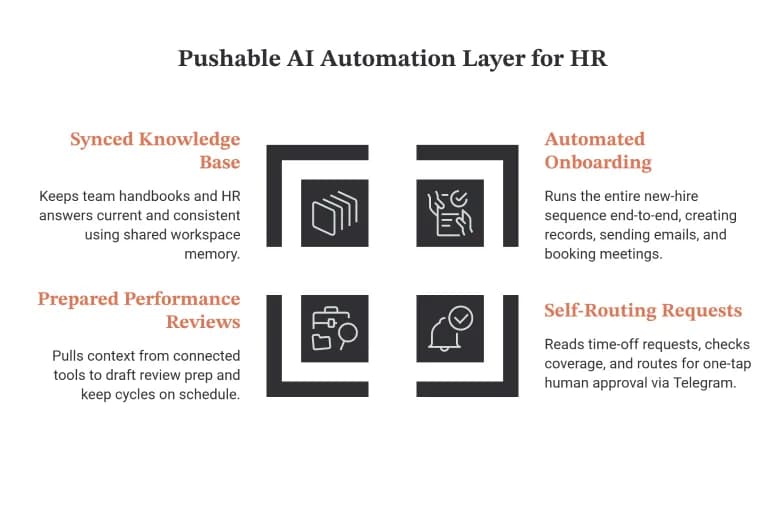
Think of it as the difference between a spreadsheet that lists your onboarding tasks and an agent that completes them.
1.Onboarding that finishes itself
New hire onboarding is death by a thousand small tasks: create accounts, send the handbook, schedule intro calls, collect documents, nudge the ones who forget. A Pushable HR agent runs the entire sequence end to end (creating records in your tools, sending the right emails, booking the meetings, and chasing missing paperwork), so a new hire's first week is warm and organized instead of a checklist someone forgot to open.
2.PTO and requests that route themselves
When a time off request comes in, the agent reads it, checks coverage, drafts the manager notification, and updates the calendar. Nothing important happens without sign off, though: Pushable's approval gates pause the agent mid task and ping a human on Telegram to approve in one tap, from a laptop or a phone. Automation stays fast; humans stay in control.
3.Performance reviews, prepped in advance
Instead of scrambling before review season, a Pushable agent pulls the relevant context from your connected tools, drafts review prep, and keeps cycles on schedule. Your managers walk in prepared instead of pulling an all nighter in a spreadsheet.
4.A handbook and knowledge base that stay in sync
Policy changes are useless if nobody sees them. Because every Pushable agent is grounded in your workspace's shared knowledge base, files, and memory, your team handbook and HR answers stay current and consistent, no more three versions of the truth confusion.
Traditional HR Software vs. Pushable: Record vs. Action
Traditional HR Software | Pushable AI Workspace | |
|---|---|---|
Primary job | Store and report on HR data | Execute HR workflows end to end |
When work happens | When a human logs in and does it | Continuously, via schedules and triggers, even when the team is offline |
Built for | The record | The whole team, with shared context and roles |
Human control | Manual by default | Approval gates + one tap Telegram sign off |
Tool connectivity | Limited or siloed | 100+ native integrations plus custom connectors |
Pricing model | Per seat, whether used or not | Credits spent only when an agent completes a task |
The point isn't that your existing HR software is bad. It's that a system of record and a system of action are two different jobs. You need both, and until now, the "action" half has quietly been outsourced to your already stretched HR team.
Popular HR Software vs. Pushable: A Side by Side Comparison
Here's how Pushable lines up against some of the best known Human Resources software on the market today. Notice that most of these are excellent at what they were built for, centralizing HR data, while Pushable occupies a different lane entirely: executing the work across whatever tools you already run.
Scroll the table horizontally to see every column.
Platform | Category | Best for | Core strength | Autonomous AI agents that run multi step workflows | Always on execution (no login needed) | Human in the loop approvals | Acts across your other business tools | Pricing model |
|---|---|---|---|---|---|---|---|---|
hr.my | Free cloud HRIS | Very small businesses on a tight budget | Free payroll, leave & attendance records | ✕ No | ✕ No | ⚠ Manual approvals | ⚠ Limited | Free / donation based |
PeopleForce | All in one HRIS / HCM | Growing SMBs wanting one unified suite | Core HR, recruiting, performance & engagement in one place | ⚠ Rule based workflow automation, not autonomous agents | ✕ No | ✓ Configurable approvals | ⚠ Select integrations (Slack, Outlook, Telegram, etc.) | ~$2 to $3 per employee / month |
Zoho People | HRIS within Zoho ecosystem | Teams already invested in Zoho | Affordable core HR, attendance & leave | ⚠ Automation + AI assist (Zia), not autonomous agents | ✕ No | ✓ Configurable approvals | ✓ Strong within Zoho; some external | Per employee tiers |
Pushable | AI automation & execution layer | Teams that want HR work done, not just tracked | Deploys AI agents that run onboarding, PTO, reviews & more end to end | ✓ Yes, core to the product | ✓ Yes, runs on schedules & triggers | ✓ Yes, one tap Telegram approval gates | ✓ 100+ native integrations + custom connectors | Credit based: pay only when a task completes; free tier |
HR Acuity | Employee relations & investigations | Enterprises managing ER cases & compliance | Case management, documentation & investigation tracking | ✕ Not a general workflow engine | ✕ No | ✓ Case based workflows | ⚠ Specialist, ER focused | Custom / enterprise |
(Note: Forbes Advisor's "best HR software" page is a review roundup rather than a product, so it isn't included above, but it's a useful place to research the tools listed here.)
How to read this table: if your primary need is a clean, affordable place to store and report on HR data, a dedicated HRIS like PeopleForce or Zoho People, or free tools like hr.my, may be all you need. If your primary pain is that HR work keeps piling onto humans, Pushable is the layer that picks it up and runs it, on top of whichever system of record you already own.
Why Teams Choose Pushable Over Bolting On More Point Tools
- Team native by default. Most AI tools are single player. Pushable is a shared workspace with shared memory, files, databases, and role based permissions, built for how HR teams actually work, not for one person in a chat window.
- Deep workspace context. Every agent is grounded in your real business context, so it acts on your actual policies and data instead of starting from a blank prompt.
- Human in the loop safety. For a function handling sensitive employee data, "the AI just did something" is unacceptable. Approval flows keep a person in charge of every consequential action.
- Always on. Agents run on schedules and event triggers, so onboarding, reminders, and reports keep moving overnight and on weekends.
- You pay for results, not seats. Credits are only spent when an agent actually completes a task, no bill that balloons every time you add a team member.
You can connect Gmail, Slack, Google Sheets, Notion, HubSpot and 100+ other tools in a click, then deploy an HR agent that acts across all of them. See how it works .
How to Get Started with AI Powered HR Automation
- Map your most repetitive HR workflow. Onboarding and PTO routing are the usual first wins: high volume, clear rules, low judgment required.
- Keep your system of record. Don't rip anything out. Pushable layers on top of the HR software you already have.
- Connect your tools. Plug in email, calendars, spreadsheets, and your HRIS so agents can read and write where the work actually lives.
- Deploy an agent with approval gates on. Let it draft and prepare, but require human sign off on anything that touches an employee directly.
- Expand once you trust it. Add reviews, handbook sync, and reporting as confidence grows.
You can start free and have a workspace live in about a minute.
The Bottom Line
The best Human Resources software of 2026 isn't the one with the most fields to fill in: it's the one that fills them in for you. Your record keeping tools are table stakes now. The competitive edge belongs to teams that add a system of action on top: AI agents that run HR workflows continuously, act on real business context, and keep a human in control of every decision that matters.
That's the whole idea behind Pushable. Keep the HR software you love. Let Pushable do the work.