
Business Proposal Template: The Complete Guide + Free Copy-and-Paste Template
Last updated: August 2026
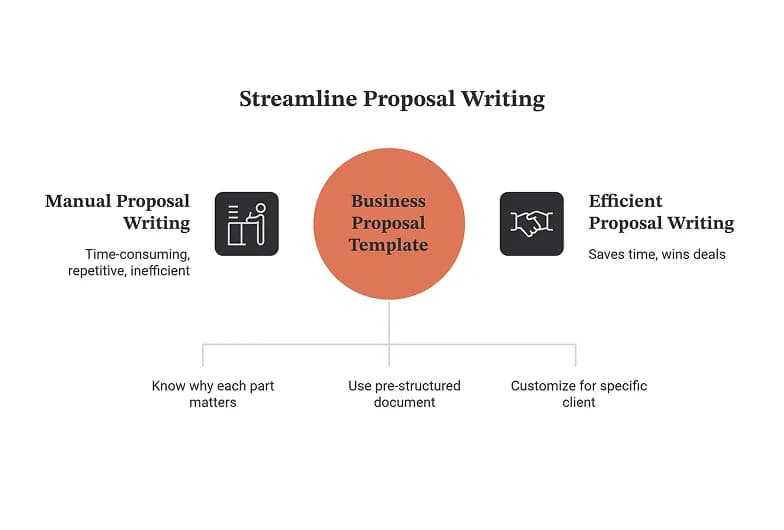
A business proposal template is a reusable, pre-structured document that lays out how your product or service solves a specific client's problem, including the scope, timeline, pricing, and terms, so you can win the deal without writing every proposal from scratch. This guide gives you the full template to copy and paste, explains what goes in each section, and walks you through writing one in seven steps.
If you only need the template, jump straight to it . Otherwise, start here: understanding why each section exists is what separates a proposal that closes from one that gets ignored.
What Is a Business Proposal?
A business proposal is a written offer sent to a prospective (or existing) client that persuades them to buy a product or service by clearly connecting their problem to your solution. Unlike a brochure, it is tailored to one specific buyer and one specific need.
A strong proposal answers five questions before the client has to ask them:
- Who are you, and what does your company do?
- What problem is the client facing?
- What solution do you offer?
- How will you deliver it: scope, timeline, and team?
- How much will it cost, and what are the terms?
Answering these upfront sets expectations, builds trust, and holds you accountable to what you've promised.
Business Proposal vs. Business Plan vs. Quote
These three documents get confused constantly, and mixing them up is one of the fastest ways to lose credibility with a client. Here's how they differ:
Document | Audience | Purpose | Focus |
|---|---|---|---|
Business proposal | A specific prospect or client | Persuade them to buy your solution | External: their problem, your fix |
Business plan | Investors, lenders, internal team | Describe how your company operates and grows | Internal: your operations and strategy |
Quote / estimate | A prospect ready to buy | State the price for defined work | Numbers only: little persuasion |
In short: a business plan looks inward at your company, a quote is just the price, and a business proposal is the persuasive bridge that connects a client's need to your offer.
The 3 Types of Business Proposals
Before you open a template, identify which situation you're in; it changes how much persuasion and research the proposal needs.
Type | When it's used | How much persuasion needed |
|---|---|---|
Formally solicited | The client issues an RFP (Request for Proposal) with detailed requirements | Low on persuasion, high on precision: answer every requirement |
Informally solicited | A prospect verbally asks you to "send something over" after a conversation | Medium: you fill gaps with your own research |
Unsolicited | You approach a prospect who didn't ask | High: you must first prove the problem exists, then that you can solve it |
A formally solicited proposal is essentially a compliance exercise: match the RFP point for point. An unsolicited proposal is the hardest, because you have to earn attention before you earn trust.
What to Include in a Business Proposal (10 Essential Sections)
Nearly every winning proposal contains the same core sections. Use this as your checklist:
- Cover page: Your company name, logo, the client's name, the proposal title, and the date.
- Cover letter or introduction: A short, warm paragraph stating why you're writing and what's inside.
- Executive summary: A one-page overview of the problem, your solution, and the outcome. Written last, read first.
- Problem / needs statement: Prove you understand the client's specific challenge, backed by their own words or data.
- Proposed solution: Exactly what you'll do and how it solves the problem.
- Scope of work and deliverables: A concrete, itemized list of what the client will receive.
- Timeline and milestones: When each phase completes, so expectations are clear.
- Pricing and payment terms: Transparent costs, broken out by deliverable or phase.
- About us / qualifications: Credentials, relevant case studies, and social proof that reduce the client's risk.
- Terms and acceptance: Legal terms, conditions, and a signature block to close.
Tip
The executive summary, problem statement, and social proof do most of the persuasive heavy lifting. Busy decision-makers often read only those three before deciding whether to keep reading.
Free Business Proposal Template (Copy and Paste)
Copy the template below and replace every [bracketed placeholder] with your details. It works for services, consulting, agencies, and most B2B offers. Keep it to as few pages as the deal genuinely needs; a focused 4-page proposal beats a padded 20-page one.
Template[YOUR COMPANY NAME]
Business Proposal Prepared for [CLIENT COMPANY NAME]
Prepared by: [Your name, title] • Date: [Date] • Valid until: [Expiration date]
1. Introduction
Dear [Client contact name],
Thank you for the opportunity to submit this proposal. Based on our conversation on [date] about [the client's challenge], we've outlined how [Your Company] can help [client company] [achieve the specific outcome]. This document covers the problem we understand you're facing, our recommended solution, the timeline, and pricing.
2. Executive Summary
[Client company] is currently [describe the problem in one or two sentences]. This is costing you [time, revenue, opportunity; quantify if possible].
[Your Company] proposes to [one-sentence description of your solution], which will [the primary benefit / outcome]. Based on similar work with [comparable client or industry], we expect this to deliver [specific, measurable result] within [timeframe].
3. Problem Statement
Through [our discussion / your RFP / our research], we understand that [client company] is facing:
- [Pain point #1, stated in the client's terms]
- [Pain point #2]
- [Pain point #3]
Left unaddressed, this is likely to [consequence: lost revenue, inefficiency, risk].
4. Proposed Solution
To solve this, we recommend the following approach:
- [Solution component 1]: [What it is and how it addresses a pain point above.]
- [Solution component 2]: [What it is and how it helps.]
- [Solution component 3]: [What it is and how it helps.]
5. Scope of Work & Deliverables
Deliverable | Description | Owner |
|---|---|---|
[Deliverable 1] | [What the client receives] | [Your team] |
[Deliverable 2] | [What the client receives] | [Your team] |
[Deliverable 3] | [What the client receives] | [Your team] |
Out of scope: [List anything explicitly excluded, to prevent scope creep.]
6. Timeline & Milestones
Phase | Milestone | Target date |
|---|---|---|
Phase 1 | [Kickoff / discovery] | [Date] |
Phase 2 | [Build / execution] | [Date] |
Phase 3 | [Delivery / launch] | [Date] |
7. Pricing & Payment Terms
Item | Cost |
|---|---|
[Deliverable / phase 1] | [$X] |
[Deliverable / phase 2] | [$X] |
[Deliverable / phase 3] | [$X] |
Total | [$X] |
Payment schedule: [e.g., 50% due on acceptance, 50% on completion.] Terms: [Payment window, e.g., net 15. Late fees, if any.]
8. Why [Your Company]
- [Relevant credential, certification, or years of experience.]
- Case study: We helped [past client] achieve [specific, measurable result].
- Testimonial: "[Short client quote.]" [Name, Title, Company]
9. Terms & Conditions
[Include your standard terms: revisions policy, cancellation, confidentiality, ownership of work, and any legal clauses relevant to your industry.]
10. Acceptance
To accept this proposal, please sign below. This proposal is valid until [expiration date].
Signature: ______________________ Date: __________ [Client name and title]
End of template.
How to Write a Business Proposal in 7 Steps
The template gives you the skeleton. These steps help you fill it with content that actually persuades.
Step 1: Research the client before you write a word
Read the RFP if there is one. Review the client's website, recent news, and competitors. The goal is to describe their problem more clearly than they could themselves; that's what signals you're the right partner.
Step 2: Nail the executive summary
Write it last, but make it strong enough to stand alone. A decision-maker should be able to read only the summary and understand the problem, your solution, and the payoff. Keep it to one page.
Step 3: Frame the problem in the client's language
Use their words, their metrics, and their stated pain points. A generic problem statement reads like a template; a specific one reads like you've done your homework.
Step 4: Make the solution concrete
Vague solutions kill deals. Instead of "we'll improve your marketing," write "we'll launch three paid campaigns targeting [segment] with a target cost-per-lead of [$X]." Specificity builds confidence.
Step 5: Justify the price with value, not just numbers
Break pricing into phases or deliverables so the client sees what each dollar buys. Where you can, tie the cost back to the outcome ("this investment recovers roughly [X] hours per month").
Step 6: Add proof
Case studies, testimonials, star ratings, recognizable client logos: social proof reduces the perceived risk of hiring you. This is often the deciding factor between two similar proposals.
Step 7: Edit, design, and make it easy to say yes
Proofread ruthlessly. Keep formatting clean and on-brand. End with a clear call to action and a simple way to accept: an e-signature block or a single "reply to approve" line removes friction.
Business Proposal Example (Excerpt)
Here's what a filled-in problem statement and solution look like for a fictional social-media agency proposing to a local restaurant group:
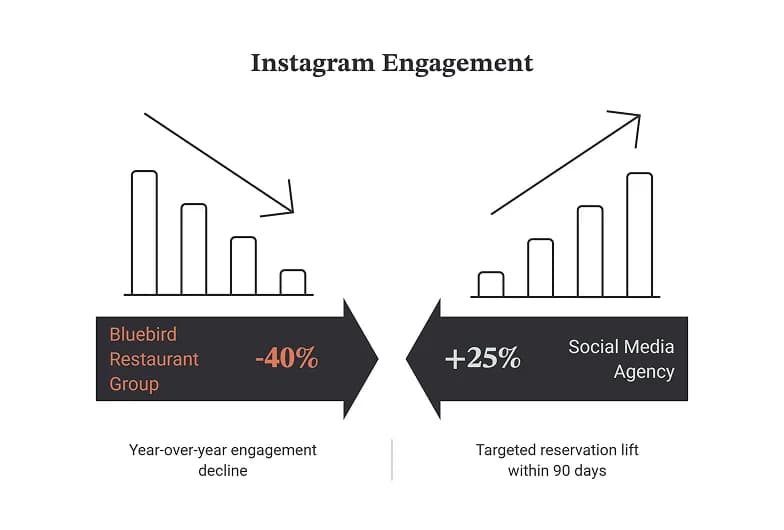
Problem statement: Based on our audit, Bluebird Restaurant Group posts to Instagram roughly twice a month with no consistent schedule, and engagement has fallen 40% year over year. Three of your four locations have no Google Business posts in the last 90 days, meaning you're invisible in local "restaurants near me" searches during peak booking windows.
Proposed solution: We'll manage a 5-post-per-week content calendar across Instagram and Google Business for all four locations, produce monthly short-form video for each venue, and run a geo-targeted paid campaign during your slow weekday dinner slots, targeting a 25% lift in reservations from social within 90 days.
Notice how the problem uses the client's actual numbers and the solution commits to a measurable target. That specificity is what turns a template into a winning proposal.
Design and Formatting Best Practices
- Keep it scannable. Use clear headings, short paragraphs (2 to 4 sentences), and bulleted lists. Most executives skim before they read.
- Lead with a table of contents for any proposal longer than a few pages.
- Stay on brand. Consistent logo, colors, and fonts signal professionalism and build trust.
- Use visuals where they clarify. Pricing tables, timeline charts, and before/after graphics communicate faster than paragraphs.
- Send as a PDF (or a trackable proposal link) so formatting stays intact across devices.
Common Mistakes to Avoid
- Making it about you, not them. Opening with three pages of company history loses the reader. Lead with their problem.
- Vague scope. Undefined deliverables invite scope creep and disputes later. Itemize everything, and list what's out of scope.
- Hiding the price or burying it in dense paragraphs. Put it in a clean table.
- No call to action. If the client finishes reading and doesn't know how to say yes, you've lost momentum.
- Sending it and going silent. A proposal is the start of a conversation, not the end. Follow up.
- Typos and inconsistent formatting. Small errors make a client wonder about the quality of your actual work.
Where to Get Templates and Proposal Tools
You can build a proposal from the copy-and-paste template above, or use a dedicated tool. Each option fits a different need:
- Word processors (Microsoft Word, Google Docs): Best if you want full control and already work in these tools. Microsoft Word offers built-in business proposal templates with AI-assisted drafting.
- Design tools (Canva): Best for visually rich, brand-heavy proposals where design matters as much as content.
- PDF tools (Adobe Acrobat): Best for polished, secure PDFs with e-signatures and interactive elements.
- Dedicated proposal software (Proposify and similar): Best for teams sending proposals at volume, with tracking, templates, and CRM integration built in.
For a one-off proposal, the template in this guide plus a word processor is usually all you need. For repeatable, high-volume sales, dedicated software pays for itself in saved time and analytics.
How to Send and Follow Up
Writing the proposal is only half the job. To actually close:
- Send it promptly while the conversation is fresh, ideally within 24 to 48 hours of your last discussion.
- Include a short, personal message rather than sending the file with no context.
- Set an expiration date on the proposal to create gentle urgency.
- Follow up within 3 to 5 business days if you haven't heard back. A brief, friendly check-in ("happy to walk you through any section") reopens the conversation without pressure.
- Make acceptance frictionless with an e-signature or a clear "reply to approve" instruction.
Final Takeaway
A great business proposal isn't about fancy design or length; it's about clearly connecting a client's specific problem to your specific solution, backing it with proof, and making it easy to say yes. Start with the copy-and-paste template above, tailor it to each client, and follow up. That combination wins deals.