
Agency Rank Tracker: The Complete 2026 Guide (Features, Tools & How to Choose)
An agency rank tracker is SEO software built to monitor keyword rankings for multiple client websites from a single dashboard, with white-label reporting, local tracking, and competitor monitoring designed around how agencies actually work. Unlike a standard rank tracker built for one site, an agency tool assumes you're juggling 10, 30, or 100+ accounts and need to prove ROI to every one of them without drowning in manual reporting.
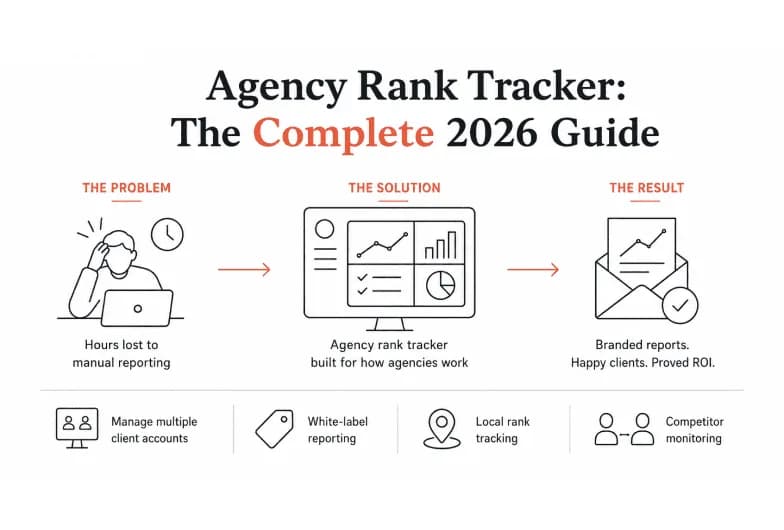
If you run an SEO, digital marketing, or web agency, the right rank tracker is the difference between spending your Monday morning copy-pasting screenshots into slides and having branded reports already sitting in your clients' inboxes. This guide covers what an agency rank tracker does, the features that actually matter, how the tools compare in 2026, and how the shift to AI search is changing what "tracking rankings" even means.
What Is an Agency Rank Tracker?
An agency rank tracker is a specialized SEO platform that records where your clients' web pages appear in search engine results pages (SERPs) for specific keywords, over time, across locations and devices. It automates a task you'd otherwise do by hand - searching Google, noting positions, repeating for every keyword and every client - and stores a historical record so you can spot trends, measure the impact of your work, and benchmark against competitors.
The "agency" distinction matters. A tool aimed at in-house teams or solo site owners optimizes for depth on a single domain. An agency-grade tracker optimizes for scale and client-facing polish: clean separation between accounts, permissioning, branded deliverables, and automation that removes humans from the reporting loop entirely.
Agency rank tracker vs. standard rank tracker
Capability | Standard rank tracker | Agency rank tracker |
|---|---|---|
Accounts | One or a few domains | Dozens to hundreds, cleanly separated |
Reporting | Basic exports | White-label, scheduled, auto-sent |
Users | Single user or small team | Team roles, client portals, permissions |
Local tracking | City-level, if any | Zip/postcode-level across many locations |
Pricing model | Per-keyword or flat | Per-client, per-project, or per-keyword tiers |
Client access | Rare | Read-only dashboards clients can log into |
Why Agencies Need a Dedicated Rank Tracker
You can track rankings with a general SEO suite or by exporting Google Search Console data. But agencies have three problems those approaches don't solve well.
- Client trust lives and dies on reporting. Rankings are the most tangible proof of your work. A branded, on-time monthly report that shows movement - or honestly explains a dip - is a retention tool. Manual reporting doesn't scale past a handful of clients before it eats your margins.
- Margins depend on automation. Every hour a strategist spends assembling reports is an hour not spent on billable strategy. Agency trackers let you build a report template once and schedule it to send forever.
- You're managing risk across a portfolio. When a core algorithm update lands, you need to see which clients moved, in which direction, immediately - not audit 40 accounts one at a time. A portfolio-level view turns a fire drill into a five-minute triage.
Must-Have Features in an Agency Rank Tracker
Not every feature is equally important. Based on how the leading tools position themselves and what agency workflows genuinely require, here are the capabilities to treat as non-negotiable table stakes versus the differentiators that separate a good tool from a great one.
Table stakes (every serious tool has these)
- Multi-client account management. Clear, permissioned separation so an account running 30+ clients can organize and navigate them without data crossover.
- White-label reporting. Your logo, colors, and ideally a custom domain on every report, so deliverables look like they came from your team - not a third-party vendor.
- Local and geo-specific tracking. Granular targeting down to city or postal-code level for multi-location and local clients.
- Competitor rank monitoring. Track competitor domains alongside client keywords, with side-by-side SERP comparisons.
- Scheduled automation and exports. Automatic refreshes and reports delivered on a cadence (PDF, CSV, Looker Studio) with no manual step.
- Daily updates across devices and engines. Desktop and mobile, Google plus Bing and others where relevant.
Differentiators (what sets the best apart)
- Share of voice / visibility score. Translates raw keyword positions into a single number clients actually understand during quarterly reviews.
- Client portals. Read-only logins where stakeholders check their own rankings, cutting down ad-hoc "can you send me an update?" requests.
- Tag-based keyword segmentation. Slice rankings by campaign, product line, funnel stage, or location for sharper client conversations.
- API and integration ecosystem. Native connections to Google Search Console, Analytics, Looker Studio, and PM tools like Asana or Jira.
- Pricing structure that fits your model. Per-keyword, per-project, or per-user pricing directly affects margin as your roster grows or shrinks - model it before you commit.
- AI search visibility tracking. Increasingly the real differentiator (more below).
The AI Search Shift: Rank Tracking in 2026
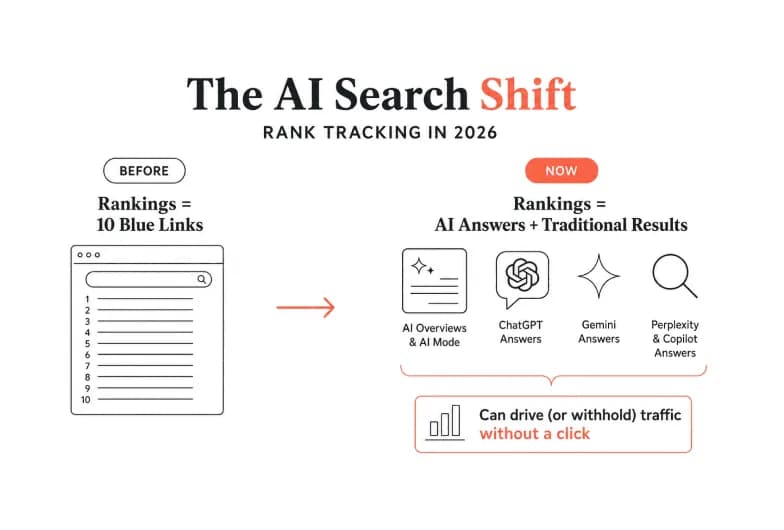
The biggest change in this category over the last two years is that "rankings" no longer means only the ten blue links. Search now includes AI Overviews, Google's AI Mode, and answers generated by ChatGPT, Gemini, Perplexity, and Copilot - surfaces that can send (or withhold) traffic without a user ever clicking a traditional result.
Nearly every modern agency rank tracker now advertises some form of AI visibility tracking: monitoring whether a client's brand is cited or recommended inside AI-generated answers, and measuring "share of voice" within those responses. For agencies, this is becoming a standalone KPI to report alongside classic organic rankings.
A grounding point worth being honest about with clients: according to Google's own guidance, optimizing for its generative AI features ("GEO" or "AEO") is not a separate discipline requiring special files, markup, or AI-specific rewrites. AI Overviews and AI Mode are grounded in the same ranking and quality systems as classic Search. The signals that earn AI citations - clear, quotable statements, strong heading hierarchy, first-party data, credible sourcing, and demonstrated expertise — are SEO fundamentals applied to a new surface. So when you evaluate a tracker's "AI features," treat them as an additional measurement layer, not a promise of a shortcut.
Practical takeaway: if a meaningful share of your clients are in informational or research-heavy niches, prioritize a tracker that reports AI Overview presence and AI-platform citations. If your clients are mostly local or transactional, granular local tracking still matters more.
How to Choose an Agency Rank Tracker
Run any shortlist through this checklist before you buy:
Factor | What to ask |
|---|---|
Scalability | Will pricing and performance hold as you go from 10 to 50 clients? |
Reporting fit | Can you fully white-label, schedule, and auto-send in the formats clients expect? |
Local precision | Does geo-targeting go as granular as your clients need (zip vs. city)? |
Data accuracy & refresh | Daily updates? Can you trigger an on-demand refresh mid-campaign? |
Integrations | Native GSC, Analytics, Looker Studio, and your PM stack? |
Pricing model | Per-client, per-keyword, or per-user - which protects your margin? |
AI visibility | Does it track AI Overviews / AI platforms, if your clients need it? |
Support & onboarding | How fast can your team get productive? |
A useful rule: buy for the workflow, not the feature list. The tool with the longest feature grid isn't automatically the best fit - the one that removes the most manual steps from your reporting process is.
Top Agency Rank Trackers Compared (2026)
The market splits roughly into three groups: agency-native platforms built around client management and reporting, all-in-one SEO suites with strong rank-tracking modules, and specialist trackers focused on accuracy and scale. Here's how some of the most visible options position themselves.
Tool | Best for | Notable angle | Starting price* |
|---|---|---|---|
AgencyAnalytics | Client reporting | Drag-and-drop branded dashboards, 80+ integrations | ~$20/client/mo |
Nightwatch | Scale + local precision | Zip-level tracking, AI platform citations, unlimited seats | ~$32/mo |
Sitechecker | All-in-one with rank tracking | White-label, AI visibility trackers, site audit built in | Trial-based |
AccuRanker | Speed and accuracy | Fast on-demand updates, unlimited domains | ~$116/mo |
SE Ranking | Budget-friendly suites | Rank tracking plus research and audits | ~$103/mo |
Whitelabel Rank | Reseller/white-label focus | Fully rebrandable tracker for resale | Varies |
*Approximate published starting prices as of 2026 and frequently bundled or billed annually - always confirm current pricing and what's included directly with each vendor, since plans change often.
Choosing between the categories
- Pick an agency-native platform (e.g., AgencyAnalytics) if reporting and client management are your bottleneck and you want reporting to be effortless.
- Pick a specialist tracker (e.g., Nightwatch, AccuRanker) if ranking accuracy, local precision, or scale is your priority and you'll handle reporting around it.
- Pick an all-in-one suite (e.g., SE Ranking, Sitechecker) if you want tracking, research, and audits under one subscription to reduce tool sprawl.
- Pick a white-label-first tool if you resell reporting as a productized service under your own brand.
There's no universal "best" - the right pick depends on client mix, team size, and whether reporting or raw tracking accuracy is your constraint.
Getting the Most Out of Your Rank Tracker
Buying the tool is step one. These habits turn it into a retention engine:
- Group keywords by intent and campaign. Tag rankings so a report can show "local pack keywords" or "blog-driven keywords" separately - clients grasp segmented stories faster than a flat list.
- Report share of voice, not just positions. A single visibility trend line survives the client who panics over one keyword dropping from #3 to #5.
- Automate delivery, then spend the saved time on narrative. The report should arrive automatically; your value is the two-paragraph summary explaining why rankings moved and what's next.
- Track competitors clients actually care about. Benchmarking against the two or three rivals a client names in every meeting makes reports feel bespoke.
- Add an AI-visibility line where it's relevant. Even a simple "your brand now appears in AI Overviews for X queries" signals you're ahead of the curve.
Common mistakes to avoid
- Obsessing over daily fluctuations. Weekly trend reviews beat daily panic for most accounts; reserve daily monitoring for active campaigns and algorithm windows.
- Over-reporting raw keyword counts. More keywords tracked ≠ more value; relevance beats volume.
- Treating tool scores as gospel. Third-party visibility scores are heuristics, not Google-internal signals - pair them with Search Console, which is the first-party source of truth.
- Neglecting local granularity. For multi-location clients, city-level tracking can hide the zip-code-level reality that actually drives foot traffic.
The Bottom Line
An agency rank tracker earns its keep by doing two things well: proving your value to clients through polished, automated reporting, and protecting your margins by removing manual work. In 2026, the strongest tools also help you measure visibility in AI-driven search - but remember that ranking well there still comes down to SEO fundamentals, not a separate playbook.
Shortlist two or three tools that match your client mix, run their free trials against your real accounts, and choose the one that removes the most steps from your reporting workflow. That's the tool that will still be worth paying for when your client roster doubles.
Note: rankings, tool features, and pricing referenced here reflect the 2026 landscape and change frequently. Verify current details directly with each vendor and validate any ranking data against Google Search Console, the first-party source.