
The 15 Best SEO Tools in 2026 (Tested, Ranked & Priced Honestly)
Quick answerFor most teams, Semrush is the best all in one SEO tool in 2026 it covers keyword research, rank tracking, site audits, content, and AI search visibility in one platform. If backlink data is your priority, Ahrefs wins. If you want value and a gentle learning curve, Moz Pro is the pick. And if your budget is $0, a stack of Google Search Console + GA4 + Bing Webmaster Tools + Google Keyword Planner will get you roughly 80% of the way there.
No single tool does everything well. The best performing SEO teams run a stack of three to four focused tools, not one platform that claims to do it all. This guide ranks the tools by the job you're hiring them to do, lists what they actually cost (including the credit limits, per seat fees, and add ons the sticker price hides), and shows you how to build a stack that fits your budget.
A note on honesty: Pricing changes constantly and every score below is our own evaluation heuristic, not an official Google signal. No SEO tool has access to Google's internal ranking data, and none can guarantee rankings. Always confirm current pricing on each vendor's official page before you buy. Figures here were checked in mid 2026.
The best SEO tools at a glance
Tool | Best for | Starting price (2026) | Free option |
|---|---|---|---|
Semrush | All in one platform (most teams) | ~$140/mo (Pro) | Limited free account |
Ahrefs | Backlink analysis & competitive research | $29/mo (Starter), $129/mo (Lite) | Free Webmaster Tools |
Moz Pro | Value & beginners | ~$49/mo (Starter) | Free tools + 30-day trial |
SE Ranking | Agency value (white-label + AI tracking) | ~$103/mo | 14-day trial |
Surfer SEO | On page content optimization | ~$99/mo | 7-day guarantee |
Screaming Frog | Technical/crawl audits | Free (500 URLs) / $279/yr | Yes |
Google Search Console | First party performance data | Free | Free |
Google Analytics 4 | Traffic & conversion attribution | Free | Free |
Clearscope / Frase | AI assisted content briefs | Frase from ~$45/mo | Limited trials |
Peec.ai / Semrush AI Visibility | Tracking citations in AI answers | Add-on / from free demo | Varies |
Prices are approximate and change frequently verify on each tool's website.
How we evaluated these tools
We ranked tools against five criteria, weighted toward what actually moves results in 2026:
- Data quality and freshness how accurate and current the keyword, backlink, and ranking data is.
- Job coverage does it do one job excellently, or several jobs adequately?
- AI search readiness can it track and help you win visibility in AI Overviews, AI Mode, ChatGPT, and Perplexity? This is now a first class requirement, not a bonus.
- True cost the real number after credit caps, per seat fees, and add ons, not just the headline price.
- Who it's built for solo creators, in house teams, and agencies have very different needs.
Cross check any third party tool's numbers against Google Search Console, which is the only source of true first party data about how your site performs in Google.
The 2026 shift: why AI search changed the tool game
Before the tool list, understand what changed because it changes what your tools need to measure.
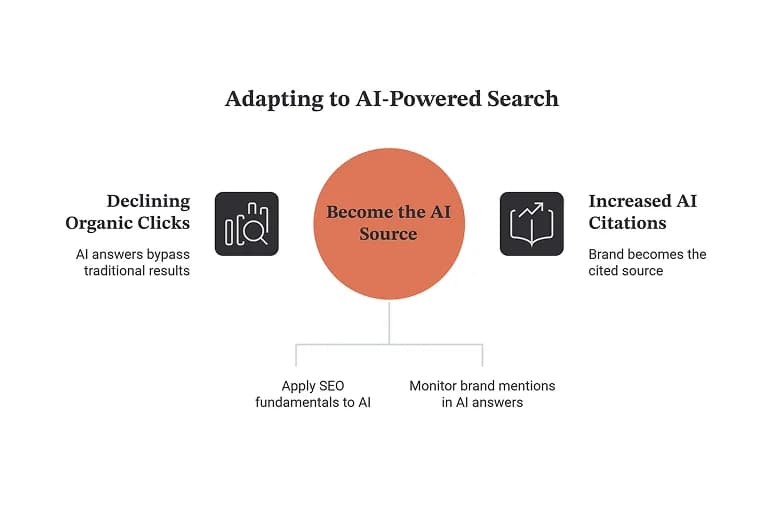
AI answers now sit above the results. Google's AI Overviews and its conversational AI Mode answer many queries directly on the results page, and assistants like ChatGPT and Perplexity answer them with no results page at all. Ranking #1 matters less when the answer above you never earns the click. The counter move is to become the source those answers cite.
GEO and AEO entered the vocabulary. "Generative Engine Optimization" and "Answer Engine Optimization" are the new labels but here's the honest version: Google's own documentation states that AI Overviews and AI Mode are grounded in the same ranking and quality systems as classic Search. In other words, GEO/AEO is mostly rebranded SEO applied to AI surfaces. You don't need special AI files, markup, or content chunking. The fundamentals quotable statements, clear attribution, strong heading hierarchy, freshness, and genuine expertise are what get you cited.
AI visibility became its own KPI. Smart teams now track brand mentions and citations inside AI answers alongside traditional rankings and traffic. Several tools below were built specifically to measure this.
Best all in one SEO platforms
1. Semrush best overall for most teams
Semrush is the most complete SEO platform available and the tool most teams should reach for first. It combines keyword research, rank tracking, site audits, content optimization, competitive analysis, and AI visibility tracking (across ChatGPT, Perplexity, and Google AI Mode) in a single dashboard. Its competitor analysis tooling seeing rivals' keywords, ad strategies, and backlink profiles is its standout strength.
Pricing (2026): Pro at $139.95/mo ($117.33/mo billed annually), Guru at $249.95/mo, Business at $499.95/mo.
Watch the hidden costs. The Pro plan includes only one user seat; extra seats run $45–$100/mo depending on tier. Add ons stack on top Local SEO ($30/mo), Content ($60/mo), AI Visibility ($99/mo), and the Trends toolkit ($289/mo) are billed separately. A five person team on Guru can easily pass $6,000/year once seats are added.
Best for: In house marketing teams and agencies that want breadth from one platform. Skip if: you only need one job done and want to avoid paying for a suite.
2. Ahrefs best for backlinks and competitive research
Ahrefs is the reference standard for backlink data the index is deep, refreshes quickly, and its link building workflows (like link intersect) run across one massive dataset. Its organic traffic estimates have improved noticeably and now track closer to real Search Console numbers.
Pricing (2026): Starter $29/mo (monthly only), Lite $129/mo (~$108 annual), Standard $249/mo, Advanced $449/mo, Enterprise from $1,499/mo.
The credit system caveat. Ahrefs moved to a usage based (credit) model that many long time users dislike. On Lite you get a limited monthly credit pool, and every filter, report, or URL analysis spends credits a single migration audit can burn a whole month's allocation. Content Explorer (the link prospecting feature most SEOs want) only unlocks at Standard. There's no traditional free trial, and no white label reporting at any tier.
Best for: Link building focused SEOs and competitive researchers. Skip if: you're a light user who'll be frustrated by credit limits.
3. Moz Pro best value and the friendliest on ramp
Moz Pro leads on simplicity and price at the entry level. Its Domain Authority metric is an industry shorthand, its interface is approachable, and its free tools (below) are genuinely useful. It doesn't match Semrush's breadth or Ahrefs' backlink depth, but for small agencies and content teams running straightforward campaigns, it delivers most of what you need without the complexity.
Pricing (2026): Starter around $49/mo, Standard around $99/mo. API access requires the higher Advanced tier.
Best for: Beginners, small agencies, and anyone who values ease of setup over raw depth.
4. SE Ranking best value for agencies
SE Ranking has quietly become the small business and agency sweet spot: accurate rank tracking by location and device, competitor monitoring, site audits, and crucially white label reporting and AI search tracking (ChatGPT, Perplexity, AI Overviews, Gemini) bundled in rather than sold as add ons. That bundling makes its effective cost per client lower than the big two once you factor in reporting.
Pricing (2026): From around $103/mo, with white label included on all plans.
Best for: Agencies managing multiple client sites who need branded reports without a separate reporting subscription.
Best specialist SEO tools
5. Surfer SEO best for on page content optimization
Surfer grades your draft in real time against the pages already ranking, using NLP to surface the terms and topical coverage top results share. That same semantic completeness is exactly what AI Overviews and Perplexity look for when deciding what's citation worthy, which makes Surfer doubly relevant in 2026. It's not a replacement for a full keyword research platform most teams run it alongside Semrush or Ahrefs.
Pricing (2026): From around $99/mo; an AI tracking add on is available separately.
6. Screaming Frog best for technical audits
The SEO Spider is the power user's crawler: granular configuration, custom extraction, and API integrations that no cloud crawler matches at the price. It's desktop software, so it's limited by your own hardware, but the value is unbeatable.
Pricing (2026): Free for up to 500 URLs; $279/year for a single seat license (volume discounts above five seats). For small sites, the free tier is genuinely sufficient.
7. Clearscope & Frase best AI assisted content briefs
Both turn a target keyword into a content brief with the entities and subtopics you need to cover. Frase is the budget friendlier option (briefs and optimization from around $45/mo); Clearscope is the premium, polished choice favored by editorial teams. Either one shortens the distance between "keyword" and "comprehensive draft."
Best free SEO tools
You can run a legitimate SEO program before spending a dollar. Build this foundation first, then add paid tools only where the free stack falls short.
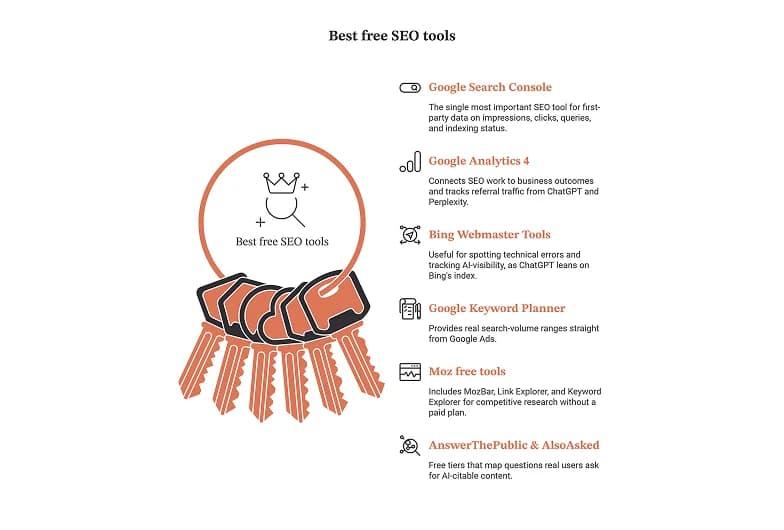
- Google Search Console (free) the single most important SEO tool. It's the only source of true first party data on your impressions, clicks, queries, and indexing status. No third party tool can replicate this accuracy. Its experimental natural language filtering can even surface question queries and emerging AI driven clicks.
- Google Analytics 4 (free) connects SEO work to business outcomes and, in 2026, is where referral traffic from ChatGPT and Perplexity shows up first.
- Bing Webmaster Tools (free) often better than GSC for spotting technical errors, and it matters more than ever because ChatGPT leans heavily on Bing's index. Bing was also the first major engine to ship its own AI visibility tracker.
- Google Keyword Planner (free) real search volume ranges straight from Google Ads.
- Moz free tools (free) MozBar, a limited Link Explorer, Keyword Explorer queries, and competitive research, all usable without a paid plan. A great starting point at moz.com/free seo tools.
- AnswerThePublic & AlsoAsked (free tiers) map the questions real users ask, which is gold for answer first, AI citable content.
Used together, these cover keyword discovery, technical monitoring, performance data, and early AI visibility signals the bulk of what agencies charge thousands a month to deliver.
Best tools for AI search visibility (GEO)
This is the newest category, and it's moving fast. These tools measure whether your brand shows up and gets cited inside AI generated answers.
- Semrush AI Visibility tracks your presence across ChatGPT, Perplexity, and Google AI Mode; available within Semrush's AI focused plans or as a ~$99/mo add on.
- Ahrefs Brand Radar / AI tracking monitors mentions of your brand and target prompts across AI Overviews, ChatGPT, and Perplexity.
- Peec.ai a specialist analytics platform that treats AI search as a visibility economy, with strong data visualizations of brand presence.
- Emerging free options several open beta GEO tools now score how "citable" your content is (schema depth, entity density) at no cost; expect pricing to arrive as they mature, so treat them as bonuses, not foundations.
Reality check: because AI surfaces run on the same ranking systems as classic Search, the best "GEO tool" is still solid fundamentals plus Google Search Console. Add a dedicated AI visibility tracker once AI answers are a meaningful share of your queries not before.
Build your stack by budget
You don't need every tool. Here's how to assemble a working stack at three budget levels.
The $0 stack (solo creators & startups)
Google Search Console + Google Analytics 4 + Bing Webmaster Tools + Google Keyword Planner + Screaming Frog (free tier) + Moz's free tools. This handles keyword research, technical audits, performance monitoring, and early AI signals.
The ~$150/month stack (freelancers & small businesses)
Add one all in one platform Moz Pro (~$99/mo) or Ahrefs Lite ($129/mo) or Semrush Pro (~$140/mo) on top of the free foundation. Choose based on your main job: Moz for ease, Ahrefs for links, Semrush for breadth.
The ~$300–500/month stack (in house teams & agencies)
A core platform (Semrush Guru or Ahrefs Standard) + Surfer SEO for content + Screaming Frog for deep audits + an AI visibility tracker. Agencies watching cost per client should seriously consider SE Ranking, which bundles white label reporting and AI tracking that the big two charge extra for.
A blended "best of breed" stack usually runs cheaper than consolidating on one premium suite but it costs you a single source of truth and adds context switching. Weigh the savings against the workflow friction.
How to choose the right SEO tool
Answer these four questions before you buy:
- What's your primary job? Keyword research, backlinks, technical audits, content optimization, and AI visibility are different jobs. Buy for the one that's currently limiting you.
- How many people and sites? Per seat fees and per project limits are where costs explode. A tool that's cheap for one user can be expensive for a team of five.
- Will credits or crawl limits bite you? Usage based pricing (Ahrefs) rewards light, targeted use and punishes heavy auditing. Fixed limits (Semrush) reward predictable workloads.
- Do you need to report to clients? If yes, white label reporting (included in SE Ranking, extra elsewhere) can swing the total cost more than the base plan.
Start with the free foundation, add one paid tool for your biggest bottleneck, and only expand the stack when a specific limitation forces the upgrade.
The bottom line
The best SEO tool depends on the job you need done, not on a single winner. Semrush is the safest all in one bet for most teams, Ahrefs owns backlink research, Moz Pro wins on value, and SE Ranking is the agency value standout. Start with the free foundation Search Console, Analytics 4, Bing Webmaster Tools then add exactly one paid tool for your biggest bottleneck.
And remember the shift that defines 2026: it's no longer only about ranking #1, but about being the source that AI answers cite. Choose tools that help you track that, then win it the way SEO has always been won with genuinely helpful, well structured, trustworthy content.
Pricing and features were verified in mid 2026 and change frequently. Confirm current details on each vendor's official pricing page before purchasing. Tool scores reflect our own evaluation criteria, not Google's internal ranking signals.